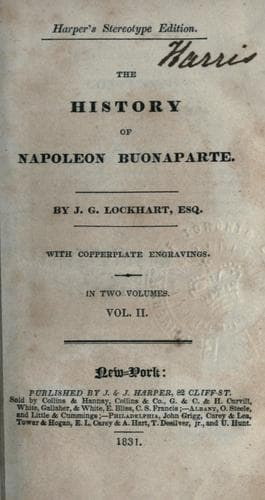
The History of Napoleon BuonaparteLockhart, J. G. (John Gibson)
History
The History of Napoleon Buonaparte
Lockhart, J. G. (John Gibson)
France -- Kings and rulers -- Biography; Napoleon I, Emperor of the French, 1769-1821
It would be rash to say that this could never have turned out in
practice a free constitution. Circumstances might have modified its
arrangements, and given the spirit of freedom to institutions not
_ex-facie_ favourable to it. But for the present it was universally
admitted that, under these new forms, the power of the state must be
virtually lodged in Buonaparte. He, in fact, named himself chief consul.
His creatures chose the conservative senate, and the conservative senate
were to choose the members of the other two assemblies. The machinery,
thus set in motion, could hardly fail to remain under his control; and,
looking at things more largely, the contrivances of making the electoral
bodies in the departments choose, not their actual representatives, but
only the persons from among whom these were to be chosen by the
conservative senate, and of preventing the legislative senate from
debating for themselves on the measures destined to pass into law,
appear to have been devised for the purpose of reducing to a mere
nullity the forms of a representative government.[32] However, the
consuls announced their manufacture to the people in these
terms:--"Citizens, the Constitution is grounded on the true principles
of a representative government, on the sacred rights of property, of
equality, and of liberty. The powers which it institutes will be
vigorous and permanent: such they should be to secure the rights of the
citizens and the interests of the state. Citizens! the Revolution is
fixed on the principles from which it originated: IT IS ENDED." And in
effect, books being opened throughout France, the names of the citizens
who inscribed their acceptance of this new constitution amounted to four
millions, while but a few votes to the contrary were registered--an
irrefragable proof that the national mind was disposed to think no
sacrifice too dear, so tranquillity could be obtained.
The circumstance, perhaps, which occasioned most surprise on the
promulgation of the new constitution, was the non-appearance of the name
of Sieyes in the list of permanent consuls. It is probable that the Abbé
made up his mind to retire, so soon as he found that Buonaparte was
capable not only of mutilating his ideal republican scheme, but of
fulfiling in his own person all the functions of a civil ruler of
France. Howbeit the ingenious metaphysician did not disdain to accept of
a large estate (part of the royal domain of Versailles!) and a large
pension besides, by way of "public recompense"--when he withdrew to a
situation of comparative obscurity, as President of the Conservative
Senate.
Public-domain text, read in full here on John Shaqi.
Reviews
Reviews
No reviews yet
Be the first to share your thoughts on this work.
Elsewhere in the archive
Join the Discussion
Join the discussion
Sign in to leave a comment or review.
Sign InorCreate an account