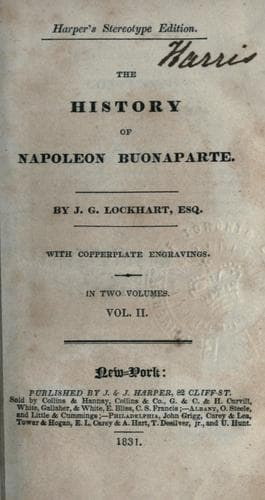
The History of Napoleon BuonaparteLockhart, J. G. (John Gibson)
History
The History of Napoleon Buonaparte
Lockhart, J. G. (John Gibson)
France -- Kings and rulers -- Biography; Napoleon I, Emperor of the French, 1769-1821
The constitution actually announced by proclamation on the 14th of
December, 1799, presents the following principal features. I. The male
citizens who are of age, and who pay taxes, in every _commune_ shall
choose a tenth of their number to be the notables of the commune; and
out of those notables the officers of the commune shall be appointed.
II. The notables of the communes constituting a _department_, shall
choose, in like manner, the tenth of their number to be the notables of
the department; and out of these the officers of the department shall be
appointed. III. The notables of all the departments shall, in the same
way, choose the tenth of their number to be notables of France; and out
of these the public functionaries of _The State_ shall be chosen. IV.
Three assemblies shall be composed of persons chosen from the notables
of France, viz.--1. The _Conservative Senate_, consisting (at first) of
twenty-four men, of forty years of age, to hold their places for life,
and to receive, each, a salary equal to 1-20th of that of the chief
consul: 2. _The Tribunate_, to be composed of 100 men, of twenty-five
years of age and upwards, of whom 1-5th go out every year, but
re-eligible indefinitely; the salary of each 15,000 francs (£625); and
thirdly, _The Legislative Senate_, composed of 300 members, of thirty
years of age, renewable by fifths every year, and having salaries of
10,000 francs (£416). V. The executive power shall be vested in three
consuls, chosen individually, as chief consul, second and third; the two
former for ten years, the last for five. VI. In order that the
administration of affairs may have time to settle itself, the tribunate
and legislative senate shall remain as first constituted for ten years,
without any re-elections. VII. With the same view, of avoiding
discussions during the unsettled state of opinion, a majority of the
members of the conservative senate are for the present appointed by the
consuls, Sieyes and Ducos, going out of office, and the consuls,
Cambaceres and Lebrun, about to come into office; they shall be held to
be duly elected, if the public _acquiesce_; and proceed to fill up their
own number, and to nominate the members of the tribunate and legislative
senate. VIII. The acts of legislation shall be proposed by the consuls:
the tribunate shall discuss and propound them to the legislative senate,
but _not vote_: the legislative senate shall hear the tribunate, and
vote, but _not debate_ themselves; and the act thus discussed and voted,
shall become law on being promulgated by the chief consul. IX.
Buonaparte is nominated chief consul, Cambaceres (minister of justice)
second, and Lebrun third consul.
Public-domain text, read in full here on John Shaqi.
Reviews
Reviews
No reviews yet
Be the first to share your thoughts on this work.
Elsewhere in the archive
Join the Discussion
Join the discussion
Sign in to leave a comment or review.
Sign InorCreate an account