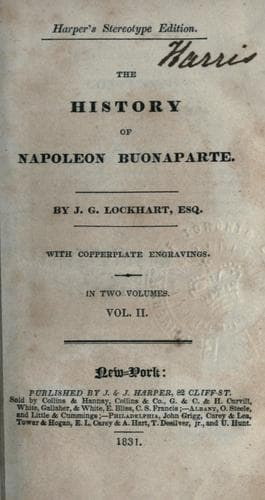
The History of Napoleon BuonaparteLockhart, J. G. (John Gibson)
History
The History of Napoleon Buonaparte
Lockhart, J. G. (John Gibson)
France -- Kings and rulers -- Biography; Napoleon I, Emperor of the French, 1769-1821
On the 17th Lannes arrived at Chatillon, where he attacked and defeated
a corps of 5000 Austrians--who received the onset of a French division
in that quarter, with about as much surprise as if an enemy had dropped
on them from the clouds. Every difficulty now seemed to be surmounted,
and corps after corps came down into the plentiful and verdant valley,
full of joy. But suddenly the march of the vanguard was arrested by an
obstacle unforeseen, or, at least, grievously under-estimated. Midway
between Aosta and Ivrea the Dora flows through a defile, not more than
fifty yards in width: the heights on either hand rise precipitous; and
in the midst an abrupt conical rock, crowned with the fortress of St.
Bard, entirely commands the river, and a small walled town, through the
heart of which lies the only passage. Lannes having vainly attempted to
force the place by a _coup de main_, a panic arose, and this spreading
to the rear, orders were given for stopping the descent of the
artillery. The Consul had come as far as the town of Aosta when this
intelligence reached him. He immediately hastened to St. Bard, where he
found the troops in much confusion.
On occasions like this Napoleon rarely failed to vindicate the
_prestige_ of his reputation. After hastily surveying the localities, he
climbed the height of the Albaredo, which rises on the one side above
the fort, and satisfied himself that, though the path had hitherto been
trodden only by solitary huntsmen, the army who had crossed the St.
Bernard might, by similar efforts, find or make their way here also. A
single cannon being, with the last difficulty, hoisted to the summit, he
planted it so as to play full on the chief bastion of St. Bard. The
moment this was arranged the troops began their painful march; and they
accomplished it without considerable loss; for the Consul's gun was so
excellently placed that the main battery of the subjacent castle, was,
ere long, silenced. The men crept along the brow of the Albaredo in
single file, each pausing (says an eye-witness) to gaze for a moment on
Napoleon, who, overcome with his exertions, had lain down and fallen
fast asleep upon the summit of the rock. Thus passed the main body,
slowly, but surely. Meantime Colonel Dufour had been ordered to scale
the wall of the town at nightfall; and his regiment (the 58th) performed
this service so impetuously, that the Austrian troops took refuge in the
castle, and the French made good their lodgment in the houses below. For
some hours the garrison poured down grape-shot at half-musket distance
upon the French, but at last out of compassion for the inhabitants, the
fire slackened, and ere day broke Buonaparte had effected his main
purpose. The streets of the town having been strewn with litter to
deafen sound, the guns, covered with straw and branches of trees, were
dragged through it under the very guns of St. Bard, and without exciting
the least suspicion in its garrison. Next morning the Austrian sent on
Public-domain text, read in full here on John Shaqi.
Reviews
Reviews
No reviews yet
Be the first to share your thoughts on this work.
Elsewhere in the archive
Join the Discussion
Join the discussion
Sign in to leave a comment or review.
Sign InorCreate an account