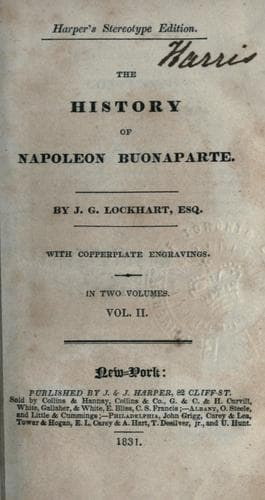
The History of Napoleon BuonaparteLockhart, J. G. (John Gibson)
History
The History of Napoleon Buonaparte
Lockhart, J. G. (John Gibson)
France -- Kings and rulers -- Biography; Napoleon I, Emperor of the French, 1769-1821
a messenger to Melas, with tidings that a large division of the French
had indeed passed by the goat-tracks of Albaredo, but that most
certainly not one great gun was with them. Buonaparte, meantime, was
hurrying forwards with horse, foot, and artillery too, upon Ivrea.
The march of the Consul received no new check until he reached the town
of Ivrea, where, after two days' hard fighting, Lannes at length forced
an entrance, and the garrison, with severe loss, withdrew. Buonaparte
then took the road to Turin, and the vanguard had another severe piece
of service at the bridge of Chiusilla, where 10,000 Austrians had been
very strongly posted. Lannes broke them, and pursuing as far as Orca,
cut them off from their magazines at Chevagno, and seized a vast
quantity of stores which had been embarked on the Po. The advance was
now within one march of Turin, while Murat occupied Vercelli, and the
other divisions (those of Moncey, Chabran, and Thureau), having
accomplished their several Alpine journeys, were pouring down upon the
low country, and gradually converging towards the appointed rendezvous
on the Ticino. Buonaparte had thus overcome the great difficulties of
his preparation, and was ready with his whole army to open the campaign
in good earnest against Melas.
The blockade of Genoa had been kept up all this time; while Suchet
resolutely maintained the last line of defence on the old frontier of
France. On the 22nd of May Melas made a desperate effort to force the
passage of the Var, but failed; and immediately afterwards received his
first intelligence of the movements of Buonaparte, and the defeat of his
own detachment at the bridge of Chiusilla. He perceived that it was high
time to leave Suchet to inferior hands, and set off to oppose in person
"the army of reserve." Suchet, on his part, was not slow to profit by
the departure of the Austrian Commander-in-chief: he, being informed of
Buonaparte's descent, forthwith resumed the offensive, re-crossed the
Var, and carried Vintimiglia at the point of the bayonet. Pursuing his
advantage, Suchet obtained the mastery, first of the defile of Braus,
and then of that of Tende, and at length re-occupied his old position at
Melagno, whence his advanced guard pushed on as far as Savona.
Public-domain text, read in full here on John Shaqi.
Reviews
Reviews
No reviews yet
Be the first to share your thoughts on this work.
Elsewhere in the archive
Join the Discussion
Join the discussion
Sign in to leave a comment or review.
Sign InorCreate an account