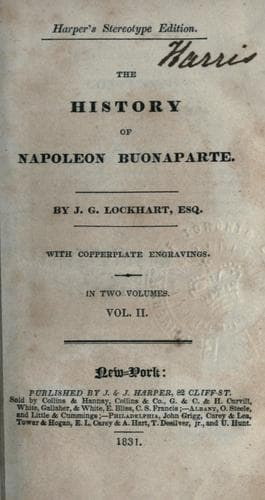
The History of Napoleon BuonaparteLockhart, J. G. (John Gibson)
History
The History of Napoleon Buonaparte
Lockhart, J. G. (John Gibson)
France -- Kings and rulers -- Biography; Napoleon I, Emperor of the French, 1769-1821
General Ott, notwithstanding this success, had been very ill-employed in
lingering before Genoa while Napoleon was so rapidly advancing; and
Melas, utterly perplexed between Suchet on the one side and the Consul
on the other, had in fact lain still, and done nothing. Buonaparte,
between the 1st and 4th of June, crossed the Ticino with his whole army.
Murat carried Turbigo on the 5th, the very day that Genoa fell; and on
the 2nd, the Chief Consul himself once more entered Milan, where he was
received with enthusiasm. Lannes, after various conflicts, occupied
Pavia. Chapon and Thureau threatened Turin by two different routes; and
Melas, at last roused to a sense of his imminent danger, abandoned the
open country of Piedmont, took up his headquarters at Alessandria, and
began to draw together his widely separated columns, and concentrate
them for the inevitable battle which must decide the fate of Italy.
Buonaparte, meanwhile, was ignorant of the fall of Genoa. He supposed,
therefore, that the army of Ott was still at a wide distance from that
of the Austrian commander-in-chief, and meditated to pass the Po
suddenly, and either attack Ott and relieve Genoa, ere Melas knew that
he was in that neighbourhood, or, if he should find this more
practicable, force Melas himself to accept battle unsupported by Ott.
Lannes and the van, accordingly, pushed on as far as Montebello, where,
to their surprise, they found the Austrians in strength. Early in the
morning of the 9th of June, Lannes was attacked by a force which he had
much difficulty in resisting. The Austrians were greatly superior in
cavalry, and the ground was favourable for that arm. But at length
Victor's division came up, and, after a severe struggle, turned the
tide. The battle was a most obstinate one. The fields being covered with
very tall crops of rye, the hostile battalions were often almost within
bayonet's length ere they were aware of each other's presence; and the
same circumstances prevented the generals, on either side, from
displaying much science in their manœuvres. It was a conflict of man
against man, and determined at a dear cost of blood. The field was
strewn with dead, and the retiring Austrians left 5000 prisoners in the
hands of Lannes--who, in memory of this day of slaughter, was created
afterwards Duke of Montebello. It was from the prisoners taken here that
the Consul learned the fate of Genoa. He immediately concluded that
Melas had concentrated his army; and, having sent messengers to Suchet,
urging him to cross the mountains by the Col di Cadibona, and march on
the Scrivia (which would place him in the rear of the enemy), halted his
whole line upon the strong position of Stradella.
Public-domain text, read in full here on John Shaqi.
Reviews
Reviews
No reviews yet
Be the first to share your thoughts on this work.
Elsewhere in the archive
Join the Discussion
Join the discussion
Sign in to leave a comment or review.
Sign InorCreate an account