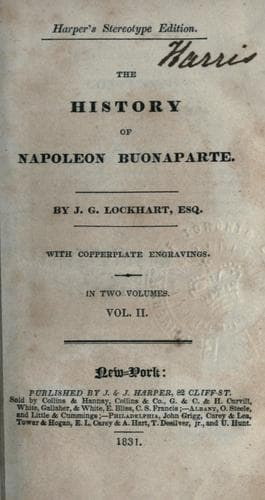
The History of Napoleon BuonaparteLockhart, J. G. (John Gibson)
History
The History of Napoleon Buonaparte
Lockhart, J. G. (John Gibson)
France -- Kings and rulers -- Biography; Napoleon I, Emperor of the French, 1769-1821
It was on the evening after Montebello, that General Dessaix, whom
Napoleon considered as second only to himself in military genius,
arrived at headquarters. Buonaparte had, as we have seen, on leaving
Egypt, ordered Kleber to send Dessaix to France in the course of
November. He had accordingly landed at Frejus shortly after the
establishment of the new government, where he found letters from the
Chief Consul, urging him to join him without delay. In these letters
there were some melancholy phrases, and Dessaix, who really loved
Napoleon, was heard to say, "He has gained all, and yet he is not
satisfied." A hundred obstacles rose up to keep Dessaix from joining his
friend so speedily as both wished. He was yet in France when the news of
St. Bernard came thither, and exclaiming, "He will leave us nothing to
do," travelled night and day until he was able to throw himself into his
arms. Napoleon immediately gave him the command of a division; and they
spent the night together in conversing about the affairs of Egypt.
The First Consul was anxious to tempt Melas to attack him at Stradella,
where the ground was unfavourable to cavalry movements; but, after lying
there unmolested for three days, he began to fear that the Austrian had
resolved, either on moving to the left flank, crossing the Ticino,
occupying Milan, and so re-opening his communications with Vienna;--or,
on falling back to Genoa, overwhelming Suchet, and taking up a position
where the British fleet could supply him with provisions--or even, in
case of necessity, embark his army, carry it round to the other side of
Italy, and by that means place him once more between his enemy and the
German states. Buonaparte, being perplexed with these apprehensions, at
last descended into the great plain of Marengo, on which he had, not
without reason, feared to abide the onset of Melas and the Austrian
horse. He was at Volghera on the 11th, and the next day at St. Juliano,
in the very centre of the plain; but still no enemy appeared. On the
13th, he advanced to the village of Marengo itself, and finding nothing
even there but a scanty outpost, which retreated before him, concluded
certainly that Melas had given him the slip, and marched either to the
left on the Ticino, or to the right on Genoa. In great anxiety he
detached one division under Dessaix to watch the road to Genoa, and
another under Murat towards the Scrivia. Dessaix was already
half-a-day's journey from headquarters, when Napoleon received
intelligence which made him hastily recall all his detachments. The
Austrian general, after a long hesitation, had at length resolved to let
a fair field decide once more the fate of Italy. On the evening of the
13th, his whole army mustered in front of Alessandria having only the
river Bormida between them and the plain of Marengo; and early in the
following morning, they passed the stream at three several points, and
advanced towards the French position in as many columns.
Public-domain text, read in full here on John Shaqi.
Reviews
Reviews
No reviews yet
Be the first to share your thoughts on this work.
Elsewhere in the archive
Join the Discussion
Join the discussion
Sign in to leave a comment or review.
Sign InorCreate an account