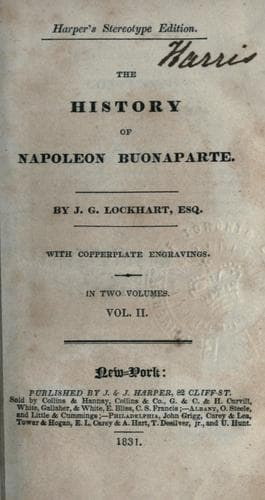
The History of Napoleon BuonaparteLockhart, J. G. (John Gibson)
History
The History of Napoleon Buonaparte
Lockhart, J. G. (John Gibson)
France -- Kings and rulers -- Biography; Napoleon I, Emperor of the French, 1769-1821
The Chief Consul, nevertheless, was not slow to avail himself of the
state of the public mind, in a manner more consistent with his prudence
and farsightedness. It was at this moment that the erection of a new
tribunal, called _the Special Commission_, consisting of eight judges,
without jury, and without revision or appeal, was proposed to the
legislative bodies. To their honour the proposal was carried by very
narrow majorities; for after that judicature was established, the Chief
Consul had, in effect, the means of disposing of all who were suspected
of political offences, according to his own pleasure. Another law which
soon succeeded, and which authorised the chief magistrate to banish
disaffected persons, as "enemies of the state," from Paris or from
France, whenever such steps should seem proper, without the intervention
of any tribunal whatever, completed (if it was yet incomplete) the
despotic range of his power: and the police, managed as that fearful
engine was by Fouché, presented him with the most perfect means of
carrying his purposes into execution.
A singular anecdote belongs to this time--(December, 1800). During the
effervescence of public opinion consequent on the affair of the infernal
machine, there appeared a pamphlet, entitled, "Parallel between Cæsar,
Cromwell, Monk, and Bonaparte"[39]--a production evidently designed to
favour the assumption of regal dignity by the Consul. Appearing at such
a moment, it could not fail to excite a vivid sensation; the
confidential friends of Napoleon assured him, in one voice, that the
publication was likely to injure him. He sent for Fouché, and reproached
him violently for suffering such a pamphlet to appear. The minister of
police heard him with perfect coolness, and replied that he had not
chosen to interfere, because he had traced the manuscript to the hotel
of his brother Lucien. "And why not denounce Lucien?" cried Napoleon;
"he ought to have been arrested instantly, and confined in the Temple."
The Consul having spoken thus, quitted the apartment, shutting the door
with violence. Fouché smiled, and whispered to De Bourienne--"Confine
the author in the Temple! Lucien showed me the manuscript; I found it
full of corrections in the handwriting of--the First Consul!" Lucien,
informed of his brother's wrath, came forthwith to the Tuileries, and
complained that "he had been made a puppet and abandoned." "The fault is
your own," answered Napoleon; "it was your business not to be detected.
Fouché has shown himself more dexterous--so much the worse for you."
Lucien resigned forthwith the office which he held in the ministry, and
proceeded as ambassador to Spain.
Public-domain text, read in full here on John Shaqi.
Reviews
Reviews
No reviews yet
Be the first to share your thoughts on this work.
Elsewhere in the archive
Join the Discussion
Join the discussion
Sign in to leave a comment or review.
Sign InorCreate an account