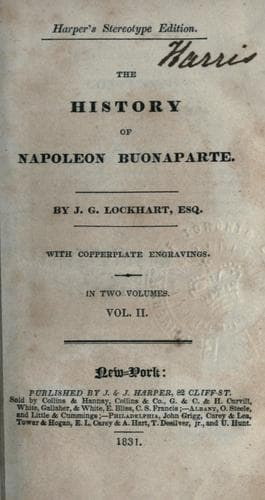
The History of Napoleon BuonaparteLockhart, J. G. (John Gibson)
History
The History of Napoleon Buonaparte
Lockhart, J. G. (John Gibson)
France -- Kings and rulers -- Biography; Napoleon I, Emperor of the French, 1769-1821
This occurred towards the middle of August; and it has been said that
the Jacobin conspirators, being thrown into the same prison with some
desperadoes of the Chouan faction, gave to these last the outline of
another scheme of assassination, which had more nearly proved
successful. This was the plot of _the infernal machine_. A cart was
prepared to contain a barrel of gunpowder, strongly fastened in the
midst of a quantity of grape-shot, which, being set on fire by a slow
match, was to explode at the moment when Buonaparte was passing through
some narrow street, and scatter destruction in every direction around
it. The night selected was that of the 10th of October, when the Chief
Consul was expected to visit the opera, and the machine was planted in
the Rue St. Nicaise, through which he must pass in his way thither from
the Tuileries. Napoleon told his friends at St. Helena, that having
laboured hard all day, he felt himself overpowered with sleep after
dinner, and that Josephine, who was anxious to be at the opera, had much
difficulty in at last rousing and persuading him to go. "I fell fast
asleep again" (he said), "after I was in my carriage; and at the moment
when the explosion took place, I was dreaming of the danger I had
undergone some years before in crossing the Tagliamento at midnight, by
the light of torches, during a flood." He awoke, and exclaimed to Lannes
and Bessieres, who were with him in the coach, "We are blown up." The
attendants would have stopped the carriage, but, with great presence of
mind, he bade them drive as fast as they could to the theatre, which he
alone of all the party entered with an unruffled countenance. He had
escaped most narrowly. The coachman, happening to be intoxicated, drove
more rapidly than was his custom.[38] The engine exploded half a minute
after the carriage had passed it--killing twenty persons, wounding
fifty-three (among whom was St. Regent, the assassin who fired the
train), and shattering the windows of several houses on both sides of
the street.
The audience in the opera-house, when the news was divulged, testified
their feelings with enthusiasm. The atrocity of the conspiracy roused
universal horror and indignation, and invested the person of the Chief
Consul with a new species of interest. The assassins were tried fairly,
and executed, glorying in their crime: and, in the momentary exaltation
of all men's minds, an edict of the senate, condemning to perpetual
exile 130 of the most notorious leaders of the _Terrorists_, was
received with applause. But Napoleon himself despised utterly the relics
of that odious party; and the arbitrary decree in question was never put
into execution.
Public-domain text, read in full here on John Shaqi.
Reviews
Reviews
No reviews yet
Be the first to share your thoughts on this work.
Elsewhere in the archive
Join the Discussion
Join the discussion
Sign in to leave a comment or review.
Sign InorCreate an account