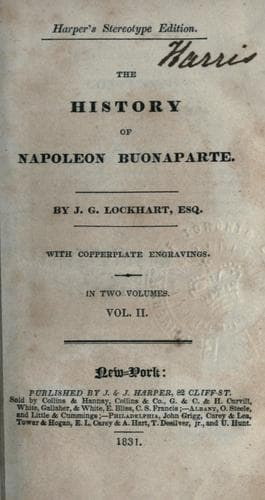
The History of Napoleon BuonaparteLockhart, J. G. (John Gibson)
History
The History of Napoleon Buonaparte
Lockhart, J. G. (John Gibson)
France -- Kings and rulers -- Biography; Napoleon I, Emperor of the French, 1769-1821
Thus far the measures of the Consulate may be said to have carried with
them the approbation of all but a few individuals. They were accompanied
or followed by proceedings, some of which roused, or strengthened and
confirmed, sentiments of a very different description among various
important classes of the French community; while others were well
calculated to revive the suspicion of all the neighbouring nations.
It is said that the first idea of the Legion of Honour arose in the
breast of Napoleon on witnessing one day, from a window at the
Tuileries, the admiration with which the crowd before the palace
regarded the stars and crosses worn by the Marquis Lucchesini,
ambassador of Prussia, as he descended from his carriage. The
republican members of the senate could not be persuaded that the
institution of an order, with insignia, was anything but the first step
to the creation of a new body of nobility; and they resisted the
proposed measure with considerable pertinacity. On this head, as on that
of the concordat with the Pope, the Consul condescended to enter
personally into discussion with the chief persons who differed from his
opinion, or suspected his intentions; and if any, who heard his language
on this occasion, doubted that both nobility and monarchy were designed
to follow hard behind the Legion of Honour, they must have been
singularly slow of understanding. _Berthier_ had called ribbons and
crosses "the playthings of monarchy," and cited the Romans of old as
"having no system of honorary rewards." "They are always talking to us
of the Romans," said Buonaparte. "The Romans had patricians, knights,
citizens, and slaves:--for each class different dresses and different
manners--honorary recompenses for every species of merit--mural
crowns--civic crowns--ovations--triumphs--titles. When the noble band of
patricians lost its influence, Rome fell to pieces--the people were vile
rabble. It was then that you saw the fury of Marius, the proscriptions
of Sylla, and afterwards of the emperors. In like manner Brutus is
talked of as the enemy of tyrants: he was an aristocrat, who stabbed
Cæsar, because Cæsar wished to lower the authority of the noble senate.
You talk of _child's rattles_--be it so: it is with such rattles that
men are led. I would not say that to the multitude; but in a council of
statesmen one may speak the truth. I do not believe that the French
people love _liberty_ and _equality_. Their character has not been
changed in ten years: they are still what their ancestors, the Gauls,
were--vain and light. They are susceptible but of one
sentiment--_honour_. It is right to afford nourishment to this
sentiment: and to allow of distinctions. Observe how the people bow
before the decorations of foreigners. Voltaire calls the common soldiers
_Alexanders at five sous a day_. He was right: it is just so. Do you
imagine that you can make men fight by reasoning? Never. You must bribe
them with glory, distinctions, rewards.
Public-domain text, read in full here on John Shaqi.
Reviews
Reviews
No reviews yet
Be the first to share your thoughts on this work.
Elsewhere in the archive
Join the Discussion
Join the discussion
Sign in to leave a comment or review.
Sign InorCreate an account