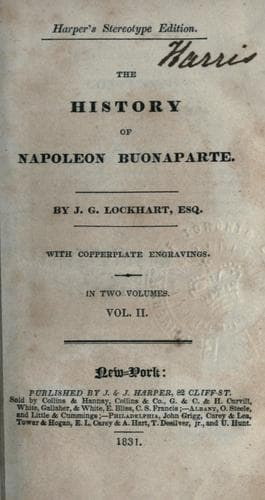
The History of Napoleon BuonaparteLockhart, J. G. (John Gibson)
History
The History of Napoleon Buonaparte
Lockhart, J. G. (John Gibson)
France -- Kings and rulers -- Biography; Napoleon I, Emperor of the French, 1769-1821
To come to the point: during ten
years there has been a talk of institutions. Where are they? All has
been overturned: our business is to build up. There is a government
with certain powers: as to all the rest of the nation what is it but
grains of sand? Before the Republic can be definitely established, we
must, as a foundation, cast some blocks of granite on the soil of
France. In fine, it is agreed that we have need of some kind of
institutions. If this Legion of Honour is not approved, let some other
be suggested. I do not pretend that it alone will save the state; but it
will do its part." Such were the words of Napoleon when the scheme was
in preparation. Many years afterwards, in his exile at St. Helena, he
thus spoke of his Order. "It was the reversion of every one who was an
honour to his country, stood at the head of his profession, and
contributed to the national prosperity and glory. Some were dissatisfied
because the decoration was alike for officers and soldiers; others
because it was given to civil and military merit indiscriminately. But
if ever it cease to be the recompense of the brave private, or be
confined to soldiers alone, it will cease to be the Legion of Honour."
On the 15th of May, 1802, the Legion of Honour was formally instituted;
large national domains were set apart for its maintenance; and crosses
(each of which entitled the bearer to certain precedence and a pension)
widely distributed among the soldiery, and among citizens of almost all
professions.
The personal authority of the future emperor, meantime, was daily
widening and strengthening. After the Consulate was established in
France, some corresponding change in the government of the Cisalpine
Republic was judged necessary, and Napoleon took care that it should be
so conducted as to give himself not only permanent, but wholly
independent, power beyond the Alps. A convention of 450 Italian deputies
was summoned to meet at _Lyons_; and there Talleyrand was ready to
dictate the terms of a new constitution, by which the executive
functions were to be lodged in a president and vice-president, the
legislative in a council chosen from three electoral colleges. It was
next proposed that Buonaparte should be invited to take on him the
office of president--Buonaparte, it was studiously explained, not as
Chief Consul of France, but in his own individual capacity. He repaired
to Lyons in person, and having harangued the convention in the Italian
tongue, assumed the dignity thus conferred on him on the 2nd of
January, 1802.
Public-domain text, read in full here on John Shaqi.
Reviews
Reviews
No reviews yet
Be the first to share your thoughts on this work.
Elsewhere in the archive
Join the Discussion
Join the discussion
Sign in to leave a comment or review.
Sign InorCreate an account