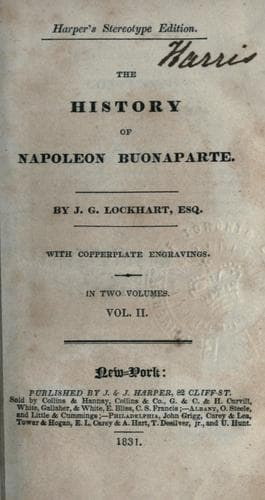
The History of Napoleon BuonaparteLockhart, J. G. (John Gibson)
History
The History of Napoleon Buonaparte
Lockhart, J. G. (John Gibson)
France -- Kings and rulers -- Biography; Napoleon I, Emperor of the French, 1769-1821
Before the end of the year he came to Paris to solicit employment; but
at first he met with nothing but repulses. The President of the Military
Committee, Aubry, objected to his youth. "Presence in the field of
battle," said Buonaparte, "might be reckoned in place of years." The
President, who had not seen much actual service, thought he was
insulted, and treated Napoleon very coldly. After a little while,
however, he was asked to go to _La Vendée_, as commandant of a brigade
of infantry. This he declined, alleging, that nothing could reconcile
him to leave the artillery, but really, if we are to follow De
Bourienne, considering the Vendean warfare as unworthy of him. His
refusal was followed by the erasure of his name from the list of general
officers _in employment_; and for a time his fortunes seemed to be in a
desperate condition. He thought of settling in some way in Paris; and
said to Bourienne, that, if he could afford to have a small house in the
street where his school-fellow lived, and to keep a cabriolet, he would
be contented. His elder brother had about this time married Mademoiselle
Clery, whose father, the merchant of Marseilles, gave her a handsome
dowry. "How fortunate," Napoleon would often exclaim, "is that fool
Joseph!"[6]
Talma, the celebrated tragedian, was one of his chief associates at this
time, and even then talked with confidence of the future fortunes of
"little Buonaparte." This player's kindness and Aubry's opposition were
both remembered. The Emperor always patronised Talma; and Aubry died in
exile.
Napoleon, despairing of employment at home, now drew up a memorial to
the government, requesting to be sent with a few other officers of
artillery into Turkey, for the purpose of placing that branch of the
Grand Seignior's service in a condition more suitable to the
circumstances of the times--in which it seemed highly probable that the
Porte might find itself in alliance with France, and assaulted by the
combined armies of Russia and Austria. No answer was returned to this
memorial, over which he dreamt for some weeks in great enthusiasm. "How
strange," he said to his friends, "would it be if a little Corsican
soldier should become King of Jerusalem!" Go where he might, he already
contemplated greatness.
At length Napoleon was nominated to the command of a brigade of
artillery in Holland. The long-deferred appointment was, no doubt, very
welcome; but in the meantime his services were called for on a nearer
and a more important field.
Public-domain text, read in full here on John Shaqi.
Reviews
Reviews
No reviews yet
Be the first to share your thoughts on this work.
Join the Discussion
Join the discussion
Sign in to leave a comment or review.
Sign InorCreate an account