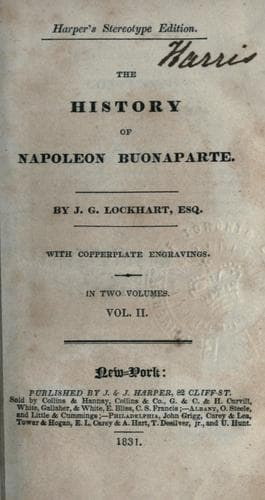
The History of Napoleon BuonaparteLockhart, J. G. (John Gibson)
History
The History of Napoleon Buonaparte
Lockhart, J. G. (John Gibson)
France -- Kings and rulers -- Biography; Napoleon I, Emperor of the French, 1769-1821
This was a most imprudent, as well as undignified proceeding; but ere
the defendant, Peltier, could be called up for judgment, the doubtful
relations of the Chief Consul and the cabinet of St. James's were to
assume a different appearance. The truce of St. Amiens already
approached its close. Buonaparte had, perhaps, some right to complain of
the unbridled abuse of the British press: but the British government had
a far more serious cause of reclamation against him. Under pretence of
establishing French consuls for the protection of commerce, he sent
persons, chiefly of the military profession, who carried orders to make
exact plans of all the harbours and coasts of the United Kingdom. These
gentlemen endeavoured to execute their commission with all possible
privacy; but the discovery of their occupation was soon made; they were
sent back to France without ceremony; and this treacherous measure of
their government was openly denounced as a violation of every rule of
international law, and a plain symptom of warlike preparation.
Ere hostilities were renewed, Buonaparte employed M. Meyer, president of
the regency of Warsaw, to open a negotiation with the head of the House
of Bourbon, then resident in Poland. He proposed that Louis should
execute a formal deed resigning for himself and his family all
pretensions to the throne of France, and offered in return to put the
Bourbon princes in possession of independent dominions in Italy. The
heir of the French kings answered in language worthy of his birth: "I do
not confound Monsieur Buonaparte," said he, "with those who have
preceded him. I esteem his bravery and military genius, and I owe him
goodwill for many of the acts of his government--for benefits done to my
people I will always consider as done to me. But he is mistaken if he
supposes that my rights can ever be made the subject of bargain and
compromise. Could they have been called in question, this very
application would have established them. What the designs of God may be
for me and my house I know not; but of the duties imposed on me by the
rank in which it was His pleasure I should be born, I am not wholly
ignorant. As a Christian, I will perform those duties while life
remains. As a descendant of St. Louis, I will know how to respect
myself, were I in fetters. As the successor of Francis the First, I
will, at least, say with him--'all is lost except honour.'"
Public-domain text, read in full here on John Shaqi.
Reviews
Reviews
No reviews yet
Be the first to share your thoughts on this work.
Elsewhere in the archive
Join the Discussion
Join the discussion
Sign in to leave a comment or review.
Sign InorCreate an account