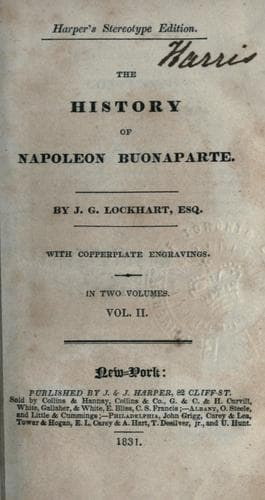
The History of Napoleon BuonaparteLockhart, J. G. (John Gibson)
History
The History of Napoleon Buonaparte
Lockhart, J. G. (John Gibson)
France -- Kings and rulers -- Biography; Napoleon I, Emperor of the French, 1769-1821
The feelings of the rival nations, however, were soon kindled into rage;
and, on either side of the Channel the language of the public prints
assumed a complexion of even more bitter violence than had been
observable during the war. The English journalists resorted to foul, and
often false and even absurd, personal criminations of the Chief Consul:
and the Parisian newspapers replied in language equally indefensible on
the score of truth and decency, but with this most essential difference,
that whereas the press of England was free, that of France, being
entirely under the control of Fouché and the police, could not, as all
men knew, put forth any such calumnies otherwise than with the consent
of the consular government. When Napoleon complained to the English
ministers, their answer was obvious: "Our courts of law are open--we are
ourselves accustomed to be abused as you are, and in them we, like you,
have our only resource." The paragraphs in the _Moniteur_, on the other
hand, were, it was impossible to deny, virtually so many manifestoes of
the Tuileries.
Of all the popular engines which moved the spleen of Napoleon, the most
offensive was a newspaper (_L'Ambigu_) published in the French language,
in London, by one Peltier, a royalist emigrant; and, in spite of all the
advice which could be offered, he at length condescended to prosecute
the author in the English courts of law. M. Peltier had the good fortune
to retain, as his counsel, Mr. Mackintosh,[45] an advocate of most
brilliant talents, and, moreover, especially distinguished for his
support of the original principles of the French Revolution. On the
trial which ensued, this orator, in defence of his client, delivered a
philippic against the personal character and ambitious measures of
Napoleon, immeasurably more calculated to injure the Chief Consul in
public opinion throughout Europe, than all the efforts of a thousand
newspapers; and, though the jury found Peltier guilty of libel, the
result was, on the whole, a signal triumph to the party of whom he had
been the organ.
Public-domain text, read in full here on John Shaqi.
Reviews
Reviews
No reviews yet
Be the first to share your thoughts on this work.
Elsewhere in the archive
Join the Discussion
Join the discussion
Sign in to leave a comment or review.
Sign InorCreate an account