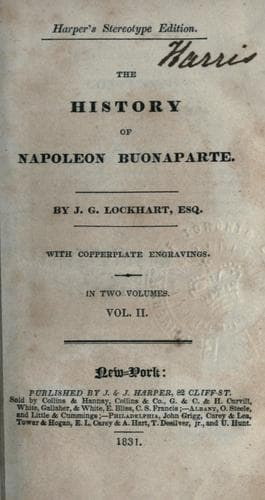
The History of Napoleon BuonaparteLockhart, J. G. (John Gibson)
History
The History of Napoleon Buonaparte
Lockhart, J. G. (John Gibson)
France -- Kings and rulers -- Biography; Napoleon I, Emperor of the French, 1769-1821
Stung to the quick by these continual invectives, Napoleon so far
descended from his dignity as to make them the subject of personal
complaint and reproach to the English Ambassador. He obtruded himself on
the department of Talleyrand, and attempted to shake the resolution of
the ambassador, Lord Whitworth, by a display of rude violence, such as
had, indeed, succeeded with the Austrian envoy at Campo-Formio, but
which produced no effect whatever in the case of this calm and
high-spirited nobleman. The first of their conferences took place in
February, when the Consul harangued Lord Whitworth for nearly two hours,
hardly permitting him to interpose a word on the other side of the
question. "Every gale that blows from England is burdened with enmity,"
said he; "your government countenances Georges, Pichegru, and other
infamous men, who have sworn to assassinate me. Your journals slander
me, and the redress I am offered is but adding mockery to insult. I
could make myself master of Egypt to-morrow, if I pleased. _Egypt,
indeed, must sooner or later belong to France_; but I have no wish to go
to war for such a trivial object. What could I gain by war? Invasion
would be my only means of annoying you; and invasion you shall have, if
war be forced on me--but I confess the chances would be an hundred to
one against me in such an attempt. In ten years I could not hope to have
a fleet able to dispute the seas with you: but, on the other hand, the
army of France could be recruited in a few weeks to 480,000 men. United,
we might govern the world:--Why can we not understand each other?" Lord
Whitworth could not but observe the meaning of these hints, and
answered, as became him, that the King of England had no wish but to
preserve his own rights, and scorned the thought of becoming a partner
with France in a general scheme of spoliation and oppression. They
parted with cold civility, and negotiations were resumed in the usual
manner: but England stood firm in the refusal to give up Malta--at least
for ten years to come. The aggressions of Napoleon had wholly changed
the arrangement of territory and power contemplated when the treaty of
Amiens was drawn up; what security could there be for the retention of
Malta by Naples, or any such minor power, if Buonaparte wished to have
it? To surrender it would in fact be to yield an impregnable harbour and
citadel in the heart of the Levant, to a government which had gone on
trampling down the independence of state after state in the west.
Meanwhile the English government openly announced, in Parliament, that
the position of affairs seemed to be full of alarm--that the French were
manning fleets and recruiting their armies, and that it was necessary to
have recourse to similar measures; and, accordingly, a considerable
addition to the military establishment was agreed to.
Public-domain text, read in full here on John Shaqi.
Reviews
Reviews
No reviews yet
Be the first to share your thoughts on this work.
Elsewhere in the archive
Join the Discussion
Join the discussion
Sign in to leave a comment or review.
Sign InorCreate an account