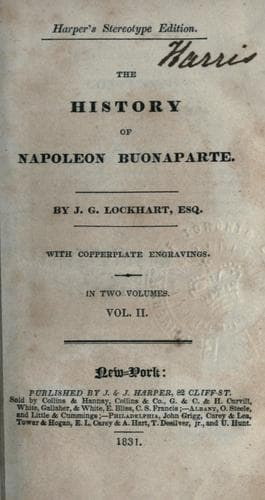
The History of Napoleon BuonaparteLockhart, J. G. (John Gibson)
History
The History of Napoleon Buonaparte
Lockhart, J. G. (John Gibson)
France -- Kings and rulers -- Biography; Napoleon I, Emperor of the French, 1769-1821
Thus stood matters on the 13th of March, when Lord Whitworth made his
appearance at the levee of the Chief Consul, in company with all the
rest of the diplomatic body. Napoleon no sooner entered, than, fixing
his eye on the English Ambassador, he exclaimed aloud and fiercely, in
presence of the circle, "You are then determined on war!" Lord Whitworth
denied the charge, but the Consul drowned his voice, and pursued
thus:--"We have been at war for fifteen years--you are resolved to have
fifteen years more of it--you force me to it." He then turned to the
other ministers, and said, in the same violent tone: "The English wish
for war; but if they draw the sword first, I will be the last to sheath
it again. They do not respect treaties--henceforth we must cover them
with black crape." Then, turning again to Whitworth, "To what purpose,"
he cried, "are these armaments? If you arm, I will arm too; if you
fight, I can fight also. You may destroy France, but you cannot
intimidate her." "We desire neither to injure nor to alarm her, but to
live on terms of good intelligence," said Lord Whitworth. "Respect
treaties, then," said Napoleon; "woe to those by whom they are not
respected!--they shall be responsible to Europe for the result." He
repeated these last words sternly, and immediately quitted the
apartment, leaving the assembled ministers utterly confounded by this
indecent display of violence.
Some persons, who knew Buonaparte well, have always asserted that this
undignified scene was got up with calm premeditation, and that the
ferocity of passion on the occasion was a mere piece of acting. Lord
Whitworth, however, was an excellent judge of men and manners, and he
never doubted that the haughty soldier yielded to the uncontrollable
vehemence of wrath. The cautious Talleyrand made various efforts to
explain away the intemperate words of his master; but they, and the tone
in which they had been uttered, went far to increase the jealousy and
animosity of the English government and nation, and to revive or confirm
the suspicion with which the other powers of Europe had had but too much
reason to regard the career of revolutionary France.
Public-domain text, read in full here on John Shaqi.
Reviews
Reviews
No reviews yet
Be the first to share your thoughts on this work.
Elsewhere in the archive
Join the Discussion
Join the discussion
Sign in to leave a comment or review.
Sign InorCreate an account