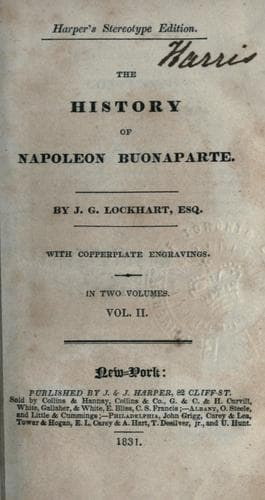
The History of Napoleon BuonaparteLockhart, J. G. (John Gibson)
History
The History of Napoleon Buonaparte
Lockhart, J. G. (John Gibson)
France -- Kings and rulers -- Biography; Napoleon I, Emperor of the French, 1769-1821
The spirit of England, on the other hand, was effectually stirred. Her
fleets, to the amount of not less than 500 ships of war, traversed the
seas in all directions, blockaded the harbours of the countries in which
the power of the Consul was predominant, and from time to time made
inroads into the French ports, cutting out and destroying the shipping,
and crippling the flotillas. At home the army, both regular and
irregular, was recruited and strengthened to an unexampled extent. Camps
were formed along the English coasts opposite to France, and the King in
person was continually to be seen in the middle of them. By night
beacons blazed on every hill-top throughout the island; and the high
resolution of the citizen-soldiery was attested, on numberless
occasions of false alarm, by the alacrity with which they marched on the
points of supposed danger.[47] There never was a time in which the
national enthusiasm was more ardent and concentrated; and the return of
Pitt to the prime-ministry (March, 1804) was considered as the last and
best pledge that the councils of the sovereign were to exhibit vigour
commensurate with the nature of the crisis. The regular army in Britain
amounted, ere long, to 100,000; the militia to 80,000; and of volunteer
troops there were not less than 350,000 in arms.
Soult, Ney, Davoust, and Victor were in command of the army designed to
invade England, and the Chief Consul personally repaired to Boulogne,
and inspected both the troops and the flotilla. He constantly gave out
that it was his fixed purpose to make his attempt by means of the
flotilla alone; but while he thus endeavoured to inspire his enemy with
false security (for Nelson had declared this scheme of a boat invasion
to be _mad_, and staked his whole reputation on its miserable and
immediate failure, if attempted), the Consul was in fact providing
indefatigably a fleet of men-of-war, designed to protect and cover the
voyage. These ships were preparing in different ports of France and
Spain, to the number of fifty; Buonaparte intended them to steal out to
sea individually or in small squadrons, rendezvous at Martinico, and,
returning thence in a body, sweep the Channel free of the English for
such a space of time at least as might suffice for the execution of his
great purpose. These designs, however, were from day to day thwarted by
the watchful zeal of Nelson and the other English admirals; who observed
Brest, Toulon, Genoa, and the harbours of Spain so closely, that no
squadron, nor hardly a single vessel, could force a passage to the
Atlantic.
Public-domain text, read in full here on John Shaqi.
Reviews
Reviews
No reviews yet
Be the first to share your thoughts on this work.
Elsewhere in the archive
Join the Discussion
Join the discussion
Sign in to leave a comment or review.
Sign InorCreate an account