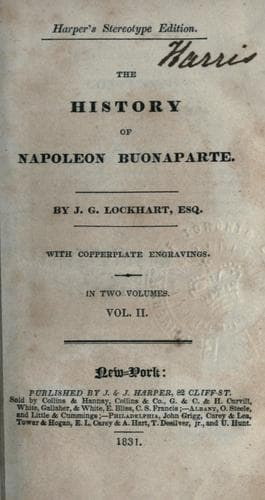
The History of Napoleon BuonaparteLockhart, J. G. (John Gibson)
History
The History of Napoleon Buonaparte
Lockhart, J. G. (John Gibson)
France -- Kings and rulers -- Biography; Napoleon I, Emperor of the French, 1769-1821
Napoleon persisted to the end of his life in asserting his belief that
the invasion of England was prevented merely by a few unforeseen
accidents, and that, had his generals passed the sea, they must have
been successful. The accidents to which he attributed so much influence,
were, it is to be supposed, the presence and zeal of Nelson, Pellew,
Cornwallis, and their respective fleets of observation. As for the
results of the expedition, if the Channel had once been
crossed--Napoleon never seemed to doubt that a single great battle would
have sufficed to place London in his hands. Once arrived in the capital,
he would, he said, have summoned a convention, restored the mass of the
English people to their proper share of political power,--in a word,
banished the King, and revolutionised England on the model of France:
the meaning of all which is--reduced this island to be a province of the
French empire, and yet bestowed upon its people all those rights and
liberties of which he had already removed the last shadow, wherever his
own power was established on the continent.
There can be little doubt that Napoleon egregiously underrated the
resistance which would have been opposed to his army, had it effected
the voyage in safety, by the spirit of the British people, and the great
natural difficulties of the country through which the invaders must have
marched. Nevertheless, it is not to be denied that, had the attempt been
made instantly on the rupture of the peace, the chances of success might
have been considerable--of success, temporary and short-lived indeed,
but still sufficient to inflict a terrible injury upon this country--to
bathe her soil in blood--to give her capital to the flames--and not
impossibly to shake some of her institutions. The enemy himself was, in
all likelihood, unprepared to make the attempt, until England had had
time to make adequate preparation for its encounter. It was otherwise
ordered of God's providence, than that the last bulwark of liberty
should have to sustain the shock of battle at its own gates.
The invasion of England was the great object of attention throughout
Europe during the autumn and winter of 1803. Early in the succeeding
year Paris itself became the theatre of a series of transactions which
for a time engrossed the public mind.
Public-domain text, read in full here on John Shaqi.
Reviews
Reviews
No reviews yet
Be the first to share your thoughts on this work.
Elsewhere in the archive
Join the Discussion
Join the discussion
Sign in to leave a comment or review.
Sign InorCreate an account