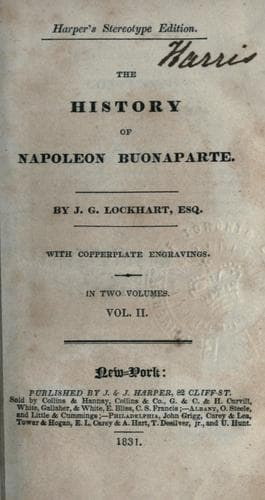
The History of Napoleon BuonaparteLockhart, J. G. (John Gibson)
History
The History of Napoleon Buonaparte
Lockhart, J. G. (John Gibson)
France -- Kings and rulers -- Biography; Napoleon I, Emperor of the French, 1769-1821
It was now openly circulated that England and the exiled Bourbons had
been detected in a base plot for murdering the Chief Consul; that the
proof of their guilt was in the hands of the government, and would soon
be made public. The Duke de Berri himself, it was added, had been
prepared to land on the west coast of France, whenever Pichegru or
Cadoudal should inform him that the time was come; while another of the
royal exiles lay watching the event, and in readiness to profit by it,
on the other side, immediately behind the Rhine.
The name of this last prince, the heir of Condé, well known for the
brilliant gallantry of his conduct while commanding the van of his
grandfather's little army of exiles, and beloved for many traits of
amiable and generous character, had hardly been mentioned in connection
with these rumours, ere the inhabitants of Paris heard, in one breath,
with surprise and horror, that the Duke d'Enghien had been arrested at
Ettenheim, and tried and executed within sight of their own houses at
Vincennes. This story will ever form the darkest chapter in the history
of Napoleon.
The duke had his residence at a castle in the Duchy of Baden, where,
attended by a few noble friends, the partakers of his exile, he was
chiefly occupied with the diversions of the chase. On the evening of the
14th of March, a troop of French soldiers and gens-d'armes, under
Colonel Ordonner (who derived his orders from Caulaincourt) suddenly
passed the frontier into the independent territory of Baden, surrounded
the Castle of Ettenheim, rushed into the apartment of the prince, and
seized him and all his company. He would have used his arms, but his
attendants, representing the overpowering number of the assailants,
persuaded him to yield without resistance. He was forthwith conveyed to
the citadel of Strasburg, and separated from all his friends except one
aide-de-camp, the Baron de St. Jaques, and allowed no communication with
any one else. After being here confined three days, he was called up at
midnight on the 18th and informed that he must prepare for a journey. He
desired to have the assistance of his valet-de-chambre, and was refused:
they permitted him to pack up _two_ shirts, and the journey immediately
begun.
Public-domain text, read in full here on John Shaqi.
Reviews
Reviews
No reviews yet
Be the first to share your thoughts on this work.
Elsewhere in the archive
Join the Discussion
Join the discussion
Sign in to leave a comment or review.
Sign InorCreate an account