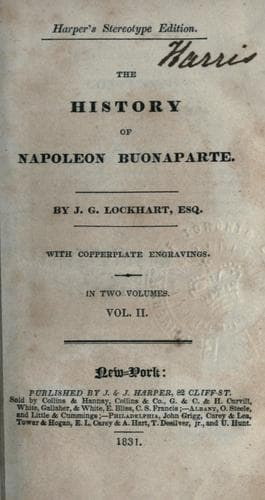
The History of Napoleon BuonaparteLockhart, J. G. (John Gibson)
History
The History of Napoleon Buonaparte
Lockhart, J. G. (John Gibson)
France -- Kings and rulers -- Biography; Napoleon I, Emperor of the French, 1769-1821
Pichegru returned from his exile at Cayenne, and after spending some
time in England, where he, no doubt, communicated with the Bourbon
princes, and with some members of Mr. Addington's government, passed
over secretly into France. Georges Cadoudal and other Chouan chiefs were
busy in stirring up their old adherents, and communicated with Pichegru
on his arrival in Paris.
Suddenly, on the 12th of February, Paris was surprised with the
announcement, that a new conspiracy against the life of the Chief Consul
had been discovered by the confession of an accomplice; that 150 men had
meant to assemble at Malmaison in the uniform of the consular guard, and
seize Buonaparte while hunting; that Georges, the Chouan, had escaped by
a quarter of an hour--but that Mairn, La Jollais, and other leaders of
the conspiracy had been taken; finally, that Moreau had held various
conferences with Georges, La Jollais and Pichegru, and that he also was
under arrest.
It is said that Georges Cadoudal had once actually penetrated into the
chamber of Napoleon at the Tuileries, and been prevented by the merest
accident from assassinating him: others of the conspirators had
approached his person very nearly on pretext of presenting petitions.
Buonaparte attributed his escape chiefly to the irregular mode of
living which his multifarious occupations involved; he seldom dined two
days following at the same hour, hardly ever stirred out of the palace
except with his attendants about him for some review or public ceremony,
and perhaps never appeared unguarded except where his appearance must
have been totally unexpected. The officer who betrayed Cadoudal and his
associates, was, it seems, a violent republican, and as such desired the
downfall of the Consul; but he had also served under Napoleon, and
learning at a late hour that the life of his old leader was to be
sacrificed, remonstrated vehemently, and rather than be accessary to
such extremities, gave the necessary information at the Tuileries.
Moreau was forthwith arrested; but Pichegru lurked undiscovered in the
heart of Paris until the 28th; six gens-d'armes then came upon his
privacy so abruptly that he could not use either his dagger or pistols,
though both were on his table. He wrestled for a moment, and then
attempted to move compassion--but was immediately fettered. Shortly
after Cadoudal himself, who had for days traversed Paris in cabriolets,
not knowing where to lay his head, was detected while attempting to pass
one of the barriers. Captain Wright, an English naval officer, who had
distinguished himself under Sir Sydney Smith at Acre, and from whose
vessel Pichegru was known to have disembarked on the coast of France,
happened about the same time to encounter a French ship of much superior
strength, and become a prisoner of war. On pretext that this gentleman
had acted as an accomplice in a scheme of assassination, he also was
immediately placed in solitary confinement in a dungeon of the Temple.
Public-domain text, read in full here on John Shaqi.
Reviews
Reviews
No reviews yet
Be the first to share your thoughts on this work.
Elsewhere in the archive
Join the Discussion
Join the discussion
Sign in to leave a comment or review.
Sign InorCreate an account