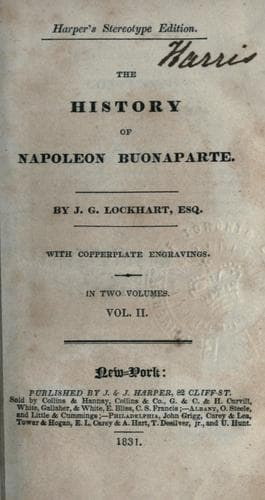
The History of Napoleon BuonaparteLockhart, J. G. (John Gibson)
History
The History of Napoleon Buonaparte
Lockhart, J. G. (John Gibson)
France -- Kings and rulers -- Biography; Napoleon I, Emperor of the French, 1769-1821
The Conventionalists themselves, however, had learned by this time that
neither peace nor security could be expected, unless some form of
government were adopted, in which the legislative and the executive
functions should at least appear to be separated; and they were also at
length inclined to admit the excellence of that part of the British
constitution, which, dividing the legislatorial power between two
assemblies of senators, thus acquires the advantage of a constant
revision of counsels, and regulates the political machine by a system of
mutual checks and balances. They were desirous, therefore, of proposing
some system which might, in a certain degree, satisfy those who had been
endeavouring to bring about the restoration of the monarchy; and the new
constitution of the year _three_ of the Republic (1795) presented the
following features. I. The executive power was to be lodged in Five
Directors, chosen from time to time, who were to have no share in the
legislation. II. There was to be a Council of Five Hundred, answering
generally to our House of Commons: and III. A smaller assembly, called
the Council of Ancients, intended to fulfil in some measure the purposes
of a House of Peers.
The outline of this scheme might perhaps have been approved of; but the
leading members of the Convention, from views personal to themselves,
appended to it certain conditions which excited new disgust. They
decreed, first, that the electoral bodies of France, in choosing
representatives to the two new Councils, must elect at least two-thirds
of the present members of Convention; and, secondly, that if full
two-thirds were not returned, the Convention should have the right to
supply the deficiency out of their own body. It was obvious that this
machinery had no object but the continuance of the present legislators
in power; and the nation, and especially the superior classes in Paris,
were indignant at conduct which they considered as alike selfish and
arbitrary. The royalist party gladly lent themselves to the diffusion of
any discontents; and a formidable opposition to the measures of the
existing government was organised.
The Convention meantime continued their sittings, and exerting all their
skill and influence, procured from many districts of the country reports
accepting of the New Constitution, with all its conditions. The
Parisians, being nearer and sharper observers, and having abundance of
speakers and writers to inform and animate them, assembled in the
several sections of the city, and proclaimed their hostility to the
Convention and its designs. The National Guard, consisting of armed
citizens, almost unanimously sided with the enemies of the Convention;
and it was openly proposed to march to the Tuileries, and compel a
change of measures by force of arms.
Public-domain text, read in full here on John Shaqi.
Reviews
Reviews
No reviews yet
Be the first to share your thoughts on this work.
Join the Discussion
Join the discussion
Sign in to leave a comment or review.
Sign InorCreate an account