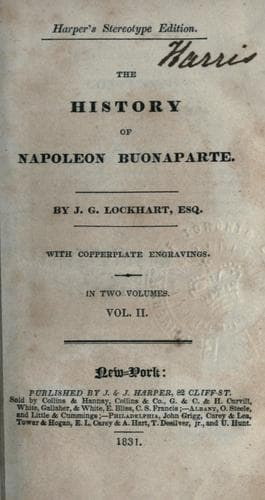
The History of Napoleon BuonaparteLockhart, J. G. (John Gibson)
History
The History of Napoleon Buonaparte
Lockhart, J. G. (John Gibson)
France -- Kings and rulers -- Biography; Napoleon I, Emperor of the French, 1769-1821
Unfortunately for Buonaparte, eight days elapsed between the order for
the arrest and the order for the execution, a much longer period than
was ever necessary for restoring the composure of his strong
understanding. Further, the Duke d'Enghien kept a diary during his
imprisonment, in which the minutest incidents are carefully recorded; it
contains no hint of the letter to Napoleon; and the Baron de St. Jaques,
who never quitted his master's chamber while he remained at Strasburg,
bears distinct testimony that no such letter was written there.
Moreover, neither Talleyrand nor any other individual in the world,
except Buonaparte, could have had the slightest motive for desiring the
death of D'Enghien. On the contrary, every motive that has weight with
mankind in general, must have swayed the other way with Talleyrand; a
member of one of the noblest families in France; a man unstained by
participation in any of the butcheries of the revolution; and, above
all, a man whose consummate skill has through life steadily pursued one
object, namely, his own personal interest, and who must have been mad to
perpetrate a gratuitous murder. And, lastly, Talleyrand was minister for
foreign affairs. A letter written at Strasburg could by no accident have
been forwarded through his department in the government; and, in fact,
there is perfect proof that the whole business was done by the police,
whose chief, Savary, communicated directly with the Chief Consul, and
the military, who acted under the orders either of Buonaparte's
aide-de-camp, Caulaincourt (afterwards Duke of Vicenza), or of his
brother-in-law, Murat, the governor of Paris. It is needless to observe,
that Napoleon's accusation of Talleyrand dates _after_ that politician
had exerted all his talents and influence in the work of procuring his
own downfall, and the restoration of the House of Bourbon. But in truth
whether Talleyrand, or Savary, or Caulaincourt, had the chief hand in
the death of the Duke d'Enghien, is a controversy about which posterity
will feel little interest. It is obvious to all men, that not one of
them durst have stirred a finger to bring about a catastrophe of such
fearful importance, without the express orders of Napoleon.
At other times the exile of St. Helena told a shorter and a plainer
tale. "I was assailed," said he, "on all hands by the enemies whom the
Bourbons had raised up against me: threatened with air-guns, infernal
machines, and stratagems of every kind. There was no tribunal to which I
could appeal for protection; therefore I had a right to protect myself.
By putting to death one of those whose followers threatened my life, I
was entitled to strike a salutary terror into all the rest."
Public-domain text, read in full here on John Shaqi.
Reviews
Reviews
No reviews yet
Be the first to share your thoughts on this work.
Elsewhere in the archive
Join the Discussion
Join the discussion
Sign in to leave a comment or review.
Sign InorCreate an account