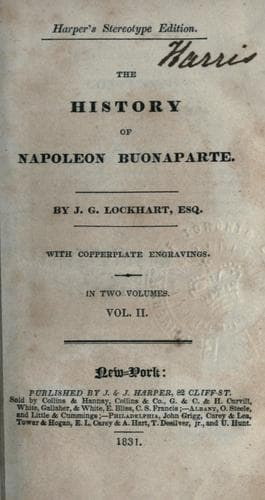
The History of Napoleon BuonaparteLockhart, J. G. (John Gibson)
History
The History of Napoleon Buonaparte
Lockhart, J. G. (John Gibson)
France -- Kings and rulers -- Biography; Napoleon I, Emperor of the French, 1769-1821
The princes of the House of Bourbon, so far from stimulating assassins
to take off the usurper of their throne, never failed, when such schemes
were suggested, to denounce them as atrocities hateful in the sight of
God and man. As to this part of their conduct, the proofs are abundant,
clear, and irrefragable. But it is very possible that Buonaparte
entertained the foul suspicion on which he justifies his violence. And
indeed it is only by supposing him to have sincerely believed that the
Bourbons were plotting against his life, that we can at all account for
the shedding of D'Enghien's blood.--Unless Josephine spake untruly, or
her conversation has been wilfully misrepresented, she strenuously
exerted her influence to procure mercy for the royal victim; and so,
unquestionably, did his venerable mother. But it demanded neither
affection for Napoleon's person, nor regard for his interest, nor
compassion for the youth and innocence of the Duke d'Enghien, to
perceive the imprudence, as well as wickedness, of the proceeding. The
remark of the callous _Fouché_ had passed into a proverb, "It was worse
than a crime--it was a blunder."
A few days after the execution of the Duke d'Enghien (on the morning of
the 7th of April) General Pichegru was found dead in prison: a black
handkerchief was tied round his neck, and tightened by the twisting of a
short stick, like a tourniquet. It could not appear probable that he
should have terminated his own life by such means; and, accordingly, the
rumour spread that he had been taken off in the night by some of the
satellites of Savary; or, according to others, by some Mamelukes whom
Napoleon had brought with him from the East, and now retained near his
person, as an interior body-guard of the palace. This is a mystery which
has never been penetrated. The recent fate of D'Enghien had prepared men
to receive any story of this dark nature; and it was argued that
Buonaparte had feared to bring Pichegru, a bold and dauntless man, into
an open court, where he might have said many things well calculated to
injure the Consul in public opinion.[49]
The other prisoners were now brought to trial. There was not a shadow of
evidence against General Moreau, except the fact, admitted by himself,
that he had been twice in company with Pichegru since his return to
Paris. He in vain protested that he had rejected the proposals of
Pichegru, to take part in a royalist insurrection; and, as for the
murderous designs of Georges Cadoudal, that he had never even heard of
them. He was sentenced to two years' confinement: but, on the
intercession of his wife with Josephine, or rather on finding that a
great part of the soldiery considered so eminent a commander as hardly
used, the Chief Consul ere long, commuted this punishment for two years
of exile.
Public-domain text, read in full here on John Shaqi.
Reviews
Reviews
No reviews yet
Be the first to share your thoughts on this work.
Elsewhere in the archive
Join the Discussion
Join the discussion
Sign in to leave a comment or review.
Sign InorCreate an account