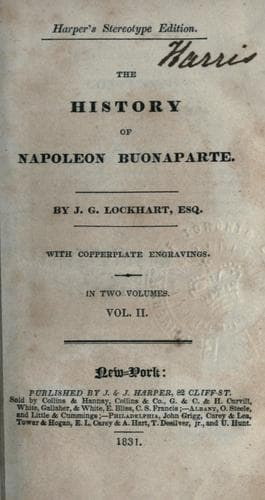
The History of Napoleon BuonaparteLockhart, J. G. (John Gibson)
History
The History of Napoleon Buonaparte
Lockhart, J. G. (John Gibson)
France -- Kings and rulers -- Biography; Napoleon I, Emperor of the French, 1769-1821
In assuming the title of Emperor, not of King, it escaped not
observation, that Napoleon's object was to carry back the minds of the
French to a period antecedent to the rule of the recently dethroned
dynasty--to the days of Charlemagne, who, with the monarchy of France,
combined both a wider dominion and a loftier style. As that great
conqueror had caused himself to be crowned by Pope Leo, so Napoleon now
determined that his own inauguration should take place under the
auspices of Pius VII.; nay, that the more to illustrate his power, the
head of the Catholic church should repair to Paris for this purpose. It
may be doubted whether, in this measure, he regarded more the mere
gratification of his pride or the chance of conferring a character of
greater solemnity on the installation of the new dynasty, in the eyes of
the Catholic population of France. On the 5th of November, however, the
unresisting Pope left Rome, and, having been received throughout his
progress with every mark of respect and veneration, arrived in Paris to
bear his part in the great pageant. On the 2nd of December Buonaparte
and Josephine appeared, amidst all that was splendid and illustrious in
their capital, and were crowned in Notre-Dame. The Pope blessed them and
consecrated the diadems; but these were not placed on their heads by his
hand. That office, in either case, Napoleon himself performed.
Throughout the ceremonial his aspect was thoughtful: it was on a stern
and gloomy brow that he with his own hands planted the symbol of
successful ambition and uneasy power, and the shouts of the deputies
present, carefully selected for the purpose, sounded faint and hollow
amidst the silence of the people.
As a necessary sequel to these proceedings in Paris, the senators of the
Italian republic now sent in their humble petition, that their president
might be pleased to do them also the favour to be crowned as their king
at Milan. The Emperor proceeded to that city accordingly, and in like
fashion, on the 26th of May, 1805, placed on his own head the old iron
crown of the Lombard kings, uttering the words which, according to
tradition, they were accustomed to use on such occasions, "_God hath
given it me. Beware who touches it._"--Napoleon henceforth styled
himself Emperor of the French and King of Italy, but announced that the
two crowns should not be held by the same person after his death.
It was not, however, for mere purposes of ceremonial that he had once
more passed the Alps. The Ligurian republic sent the Doge to Milan to
congratulate the King of Italy, and also to offer their territories for
the formation of another department of the French empire. But this was a
step of his ambition which led to serious results.
Meanwhile Eugene Beauharnois, son to Josephine, was left Viceroy at
Milan, and the imperial pair returned to Paris.
[Footnote 47: To this period belong Sir W. Scott's song to the Edinburgh
Volunteers:--
Public-domain text, read in full here on John Shaqi.
Reviews
Reviews
No reviews yet
Be the first to share your thoughts on this work.
Elsewhere in the archive
Join the Discussion
Join the discussion
Sign in to leave a comment or review.
Sign InorCreate an account