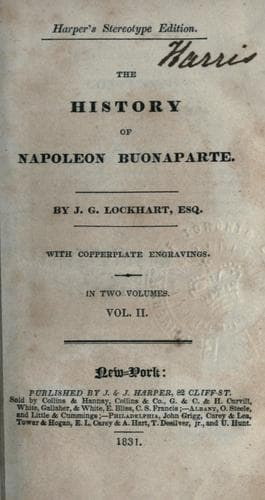
The History of Napoleon BuonaparteLockhart, J. G. (John Gibson)
History
The History of Napoleon Buonaparte
Lockhart, J. G. (John Gibson)
France -- Kings and rulers -- Biography; Napoleon I, Emperor of the French, 1769-1821
The legislative body, without hesitation, adopted it; and a
senatus-consultum forthwith appeared, by which Napoleon Buonaparte was
declared Emperor of the French: the empire to descend in the male line
of his body: in case of having no son, Napoleon might adopt any son or
grandson of his brothers as his heir: in default of such adoption,
Joseph and Louis Buonaparte were named as the next heirs of the crown
(Lucien and Jerome being passed over, as they had both given offence to
Napoleon by their marriages). The members of Napoleon's family were
declared princes of the blood of France.
This decree was sent down to the departments: and the people received it
with indifference. The Prefects reported on the 1st of December, that
between three and four millions of citizens had subscribed their assent
to the proposed measure, while not many more than three thousand voted
in opposition to it. This result indicated, as these functionaries chose
to say, the unanimous approbation of the French people. That nation,
however, consisted at the time of more than thirty millions!
But Napoleon did not wait for this authority, such as it proved to be.
On the 18th of May (more than six months ere the report reached him) he
openly assumed the imperial title and dignity. On the same day he
nominated his late colleagues in the Consulate, Cambaceres and Le Brun,
the former to be Arch-Chancellor, the latter Arch-Treasurer of the
Empire. The offices of High-Constable, Grand Admiral, &c., were revived
and bestowed on his brothers, and others of his immediate connections.
Seventeen generals (viz. Berthier, Murat, Moncey, Jourdan, Massena,
Augereau, Bernadotte, Soult, Brune, Lannes, Mortier, Ney, Davoust,
Bessieres, Kellerman, Lefebre, Perignon, Serrurier) were named Marshals
of the Empire; Duroc, Grand Marshal of the Palace; Caulaincourt, Master
of the Horse; Berthier, Grand Huntsman; and Count Segur, a nobleman of
the ancient regime, Master of the Ceremonies. It was in vain attempted
to excite popular enthusiasm. "It appeared," says an eye-witness, "as if
the shades of D'Enghien and Pichegru had hovered over the scene, and
spread coldness on all that was meant for the manifestation of joy."
It was not so with the soldiery. Napoleon, with his empress, visited the
camps at Boulogne, and was received with the excess of military applause
and devotion. He made a progress to Aix-la-Chapelle, and along the
Rhenish frontier, flattered and extolled at every station. Except
Russia, Sweden, and England, every crown in Europe sent to congratulate
him on his enrolment in the body of hereditary monarchs. Nay, not a few
of the smaller German potentates came in person, to swell, on this great
occasion, the state and magnificence of the new imperial court.
Public-domain text, read in full here on John Shaqi.
Reviews
Reviews
No reviews yet
Be the first to share your thoughts on this work.
Elsewhere in the archive
Join the Discussion
Join the discussion
Sign in to leave a comment or review.
Sign InorCreate an account