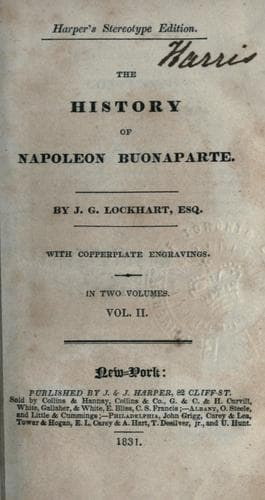
The History of Napoleon BuonaparteLockhart, J. G. (John Gibson)
History
The History of Napoleon Buonaparte
Lockhart, J. G. (John Gibson)
France -- Kings and rulers -- Biography; Napoleon I, Emperor of the French, 1769-1821
This sufficiently indicated a fact of which Napoleon had just suspicion
some time before. The murder of the Duke d'Enghien had been regarded
with horror by the young Emperor of Russia; he had remonstrated
vigorously, and his reclamations had been treated with indifference. The
King of Sweden, immediately after he heard of the catastrophe of
Vicennes, had made known his sentiments to the Czar: a strict alliance
had been signed between those two courts about a fortnight before
Napoleon wrote to the King of England; and it was obvious that the
northern powers had resolved to take part with Great Britain in her
struggle against France. The Consul now made the _Moniteur_ the vehicle
of continual abuse against the sovereigns of Russia and Sweden; and the
latter caused a note to be handed to the French minister at Stockholm,
complaining of the "indecent and ridiculous insolence which _Monsieur
Buonaparte_ had permitted to be inserted" in that official journal.
The cabinets of London, Petersburg, and Stockholm were parties in a
league which had avowedly the following objects: to restore the
independence of Holland and Switzerland: to free the north of Germany
from the presence of French troops: to procure the restoration of
Piedmont to the King of Sardinia; and, finally, the evacuation of Italy
by Napoleon. Until, by the attainment of these objects, the sway of
France should be reduced to limits compatible with the independence of
the other European states, no peace was to be signed by any of the
contracting powers; and, during several months, every means was adopted
to procure the association of Austria and Prussia. But the latter of
these sovereigns had the misfortune at this time to have a strong French
party in his council, and, though personally hostile to Napoleon, could
not as yet count on being supported in a war against him by the hearty
goodwill of an undivided people. Austria, on the other hand, had been
grievously weakened by the campaign of Marengo, and hesitated, on
prudential grounds, to commit herself once more to the hazard of arms.
Alexander repaired in person to Berlin, for the purpose of stimulating
the King of Prussia. The two sovereigns met in the vault where the great
Frederick lies buried, and swore solemnly, over his remains, to effect
the liberation of Germany. But though thus pledged to the Czar, the King
of Prussia did not hastily rush into hostilities. He did not even follow
the example of the Austrian, whose forbearance was at length wholly
exhausted by the news of the coronation at Milan, and the annexation of
Genoa to the empire of France.
Public-domain text, read in full here on John Shaqi.
Reviews
Reviews
No reviews yet
Be the first to share your thoughts on this work.
Elsewhere in the archive
Join the Discussion
Join the discussion
Sign in to leave a comment or review.
Sign InorCreate an account