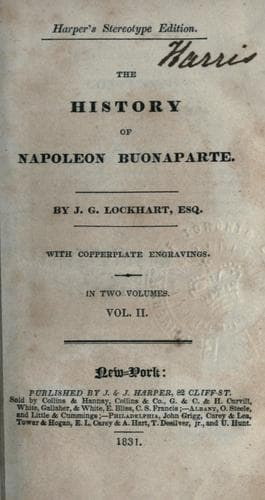
The History of Napoleon BuonaparteLockhart, J. G. (John Gibson)
History
The History of Napoleon Buonaparte
Lockhart, J. G. (John Gibson)
France -- Kings and rulers -- Biography; Napoleon I, Emperor of the French, 1769-1821
The government of Vienna no sooner heard of this new aggrandisement,
than it commenced warlike preparations, rashly and precipitately,
without making sure of the co-operation of Berlin, or even waiting until
the troops of Russia could perform the march into Germany. But this
great fault was not the greatest. The Emperor haughtily demanded that
the Elector of Bavaria should take the field also; nay, that he should
suffer his army to be entirely incorporated with the Austrian, and
commanded by its chiefs. The Elector, who had a son travelling in
France, resisted anxiously and strenuously. "On my knees," he wrote to
the Emperor, "I beg of you that I may be permitted to remain neutral."
This appeal was disregarded. The Austrian troops advanced into Bavaria,
where they appear to have conducted themselves as in an enemy's country;
and the indignant Elector withdrew his army into Franconia, where he
expected the advance of the French as liberators.
This unjustifiable behaviour was destined to be severely punished. No
sooner did Napoleon understand that war was inevitable, than he broke up
his great army on the coast opposite to England, and directed its march
upon the German frontier; while Massena received orders to assume, also,
the offensive in Italy, and force his way, if possible, into the
hereditary states of Austria. The favourite scheme of Carnot was thus
revived, and two French armies, one crossing the Rhine, and the other
pushing through the Tyrolese, looked forward to a junction before the
walls of Vienna.
The rashness which had characterised the conduct of the Cabinet of
Vienna, was fatally followed out in that of its general, Mack: instead
of occupying the line of the river Inn, which, extending from the Tyrol
to the Danube at Passau, affords a strong defence to the Austrian
territory, and on which he might have expected, in comparative safety,
the arrival of the Russians--this unworthy favourite of the Emperor left
the Inn behind him, and established his headquarters on the western
frontier of Bavaria, at Ulm.
Napoleon hastened to profit by this unpardonable error. Bernadotte
advanced from Hanover, with the troops which had occupied that
electorate, towards Wurtzburg, where the Bavarian army lay ready to join
its strength to his; five divisions of the great force lately assembled
on the coasts of Normandy, under the orders of Davoust, Ney, Soult,
Marmont, and Vandamme, crossed the Rhine at different points, all to the
northward of Mack's position; while a sixth, under Murat, passing at
Kehl, manoeuvred in such a manner as to withdraw the Austrian's
attention from these movements, and to strengthen him in his belief that
Napoleon and all his army were coming against him through the Black
Forest in his front.
Public-domain text, read in full here on John Shaqi.
Reviews
Reviews
No reviews yet
Be the first to share your thoughts on this work.
Elsewhere in the archive
Join the Discussion
Join the discussion
Sign in to leave a comment or review.
Sign InorCreate an account