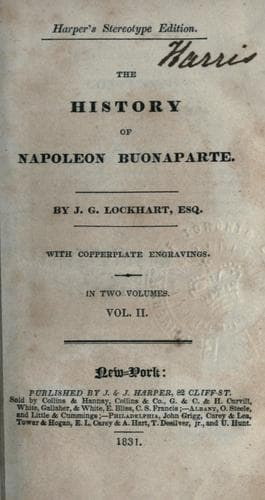
The History of Napoleon BuonaparteLockhart, J. G. (John Gibson)
History
The History of Napoleon Buonaparte
Lockhart, J. G. (John Gibson)
France -- Kings and rulers -- Biography; Napoleon I, Emperor of the French, 1769-1821
Shortly afterwards there arrived Count Haugwitz, an envoy from the King
of Prussia, who being introduced into the Emperor's presence, signified
that he was the bearer of an important communication. "Count," said
Napoleon, "you may see that the outposts of the armies are almost
meeting--there will be a battle to-morrow--return to Vienna, and deliver
your message when it is over." The envoy did not require two biddings.
Napoleon had all this year been protracting the indecision of the
Prussian counsels by holding out the delusive hope, that, were Austria
effectually humbled, the imperial crown of Germany might be transferred
to the house of Brandenburg. The old jealousies, thus artfully awakened,
had been sufficient to prevent a declaration of war from immediately
following on the violation of the territory of Anspach and Bareuth. The
intervention of the Czar had, it is not to be doubted, at length
determined the Court of Berlin to close their unworthy neutrality:--but
Haugwitz had no Prussian army in his train; and, seeing what was before
him, he certainly did prudently to defer that which had been so unwisely
as well as ungenerously put off from month to month, for one day more.
At one o'clock in the morning of the 2nd of December, Napoleon, having
slept for an hour by a watch-fire, got on horseback, and proceeded to
reconnoitre the front of his position. He wished to do so without being
recognised, but the soldiery penetrated the secret, and, lighting great
fires of straw all along the line, received him from post to post with
shouts of enthusiasm. They reminded him that this was the anniversary of
his coronation, and assured him they would celebrate the day in a manner
worthy of its glory. "Only promise us," cried an old grenadier, "that
you will keep yourself out of the fire." "I will do so," answered
Napoleon, "I shall be with the reserve _until you need us._" This
pledge, which so completely ascertains the mutual confidence of the
leader and his soldiers, he repeated in a proclamation issued at
daybreak. The sun rose with uncommon brilliancy: on many an after-day
the French soldiery hailed a similar dawn with exultation as the sure
omen of victory, and "the Sun of Austerlitz" has passed into a proverb.
Public-domain text, read in full here on John Shaqi.
Reviews
Reviews
No reviews yet
Be the first to share your thoughts on this work.
Elsewhere in the archive
Join the Discussion
Join the discussion
Sign in to leave a comment or review.
Sign InorCreate an account