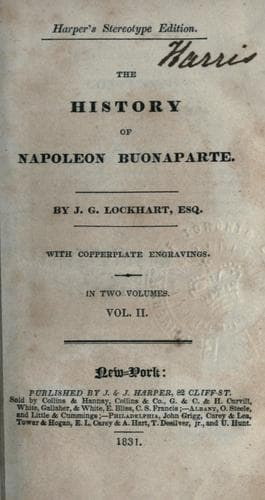
The History of Napoleon BuonaparteLockhart, J. G. (John Gibson)
History
The History of Napoleon Buonaparte
Lockhart, J. G. (John Gibson)
France -- Kings and rulers -- Biography; Napoleon I, Emperor of the French, 1769-1821
The Russian General-in-Chief, Kutusoff, fell into the snare laid for
him, and sent a large division of his army to turn the right of the
French. The troops detached for this purpose met with unexpected
resistance from Davoust, and were held in check at Raygern. Napoleon
immediately seized the opportunity. They had left a deep gap in the
line, and upon that space Soult forthwith poured a force, which entirely
destroyed the communication between the Russian centre and left. The
Czar perceived the fatal consequences of this movement, and his guards
rushed to beat back Soult. It was on an eminence, called the hill of
Pratzen, that the encounter took place. The Russians drove the French
infantry before them: Napoleon ordered Bessieres to hurry with the
imperial guard to their rescue. The Russians were in some disorder from
the impatience of victory. They resisted sternly, but were finally
broken, and fled. The Grand Duke Constantine, who had led them
gallantly, escaped by the fleetness of his horse.
The French centre now advanced, and the charges of its cavalry under
Murat were decisive. The Emperors of Russia and Germany beheld from the
heights of Austerlitz the total ruin of their centre, as they had
already of their left. Their right wing had hitherto contested well
against all the impetuosity of Lannes: but Napoleon could now gather
round them on all sides, and, his artillery plunging incessant fire on
them from the heights, they at length found it impossible to hold their
ground. They were forced down into a hollow, where some small frozen
lakes offered the only means of escape from the closing cannonade. The
French broke the ice about them by a storm of shot, and nearly 20,000
men died on the spot, some swept away by the artillery, the greater part
drowned. Buonaparte, in his bulletin, compares the horrid spectacle of
this ruin to the catastrophe of the Turks at Aboukir, when "the sea was
covered with turbans." It was with great difficulty that the two
emperors rallied some fragments of their armies around them, and
effected their retreat. Twenty thousand prisoners, forty pieces of
artillery, and all the standards of the imperial guard of Russia,
remained with the conqueror. Such was the battle of Austerlitz;--or, as
the French soldiery delighted to call it, "the battle of the emperors."
Public-domain text, read in full here on John Shaqi.
Reviews
Reviews
No reviews yet
Be the first to share your thoughts on this work.
Elsewhere in the archive
Join the Discussion
Join the discussion
Sign in to leave a comment or review.
Sign InorCreate an account