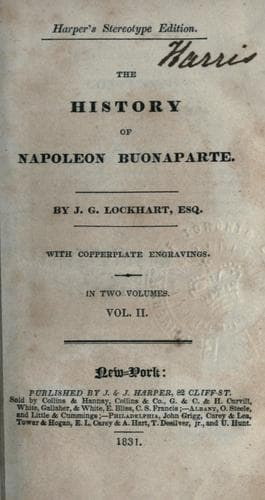
The History of Napoleon BuonaparteLockhart, J. G. (John Gibson)
History
The History of Napoleon Buonaparte
Lockhart, J. G. (John Gibson)
France -- Kings and rulers -- Biography; Napoleon I, Emperor of the French, 1769-1821
Other events of the same character now crowded on the scene. The king,
or rather the queen of Naples, had not failed, during the recent
campaign, to manifest the old aversion to the French cause. St. Cyr's
army, which on the first rupture of the peace of Amiens had occupied the
seaports of that kingdom, being called into the north of Italy to
reinforce Massena against the Archduke Charles, an Anglo-Russian
expedition soon landed in Naples, and were welcomed cordially by the
court. Napoleon, immediately after the battle of Austerlitz, issued a
proclamation, declaring that "the royal house of Naples had ceased to
reign for _ever_." On hearing of the decisive battle, and the retreat of
the Czar, the English and Russians evacuated the Neapolitan territories
on the mainland of Italy. Joseph Buonaparte conducted a French army
towards the frontier; the court passed over into Sicily; and Joseph was
proclaimed King of Naples.
The King of Sweden, rushing as hastily and inconsiderately as he of
Naples into the war of 1805, landed with a small army in Germany, and
besieged Hamelen, a fortress of Hanover, where Bernadotte had left a
strong garrison. This movement, had Prussia broken her neutrality, might
have been of high importance to the general cause; as events turned out,
it was fruitless. The Swedes raised their siege in confusion, on
receiving the news of Austerlitz; and Napoleon from that hour meditated
the dethronement of the dynasty of Gustavus--but this object was not yet
within reach.
The Principalities of Lucca, Massa-Carrara, and Garfagnana, were now
conferred on Napoleon's sister, Eliza (Madame Bacciochi): on Pauline,
the younger sister, who, after the death of General Leclerc, had married
the Prince Borghese, the sovereignty of Guastalla was in like manner
bestowed.
The Batavian republic had for years been in effect enslaved by France.
On pretence that her leading men, however, still yearned after the
alliance of England, and thwarted him in his designs on the commerce of
that great enemy, Napoleon now resolved to take away even the shadow of
Dutch independence. The Batavian Senate were commanded to ask Louis
Buonaparte for their king; and these republicans submitted with the
better grace, because the personal character of Louis was amiable, and
since Holland must be an appendage to France, it seemed probable that
the connection might be rendered the less galling in many circumstances,
were a prince of Napoleon's own blood constituted her natural guardian.
Louis had married the beautiful Hortense-Fanny de Beauharnois, daughter
of Josephine--so that, by this act, two members of the imperial house
were at once elevated to royalty.--They began their reign at the Hague
in May, 1806.
Public-domain text, read in full here on John Shaqi.
Reviews
Reviews
No reviews yet
Be the first to share your thoughts on this work.
Elsewhere in the archive
Join the Discussion
Join the discussion
Sign in to leave a comment or review.
Sign InorCreate an account