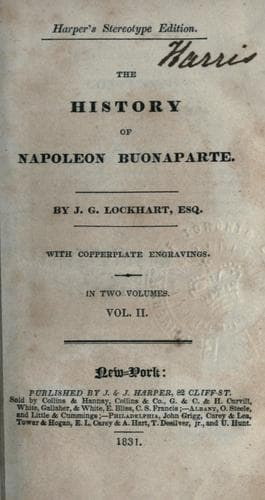
The History of Napoleon BuonaparteLockhart, J. G. (John Gibson)
History
The History of Napoleon Buonaparte
Lockhart, J. G. (John Gibson)
France -- Kings and rulers -- Biography; Napoleon I, Emperor of the French, 1769-1821
The Prussian envoy now returned, and presented to Napoleon his master's
congratulations on the victory thus achieved. The Emperor whispered to
Haugwitz, "Here is a message, of which circumstances have altered the
address." Frederick-William, however, had 150,000 men under arms, and it
by no means suited Napoleon's views to provoke him to extremities at
this moment. He entered into a treaty with Haugwitz; and Prussia was
bribed to remain quiescent, by a temptation which she wanted virtue to
resist. The French Emperor offered her Hanover, provided she would
oppose no obstacle to any other arrangements which he might find it
necessary to form: and the house of Brandenburg did not blush to accept
at his hands the paternal inheritance of the royal family of England.
The Austrian, understanding how Prussia was disposed of, perceived too
clearly that further resistance was hopeless; and negotiations
immediately begun.
The haughty Emperor of Germany repaired to the French headquarters. He
was received at the door of a miserable hut. "Such," said Buonaparte,
"are the palaces you have compelled me to occupy for these two months."
"You have made such use of them," answered Francis, "that you ought not
to complain of their accommodation."
The humiliated sovereign, having ere this obtained an armistice for
himself, demanded of Napoleon that the Czar might be permitted to
withdraw in safety to his own states. To this the conqueror assented:
and on the 6th of December the Russians commenced their retreat.
The definitive treaty with Francis was signed at Presburg on the 15th of
December, another with Prussia on the 26th, at Vienna:--and the terms of
both arranged, on Napoleon's side, by Talleyrand, corresponded with the
signal and decisive events of the campaign.
Austria yielded the Venetian territories to the kingdom of Italy: her
ancient possessions of the Tyrol and Voralberg were transferred to
Bavaria, to remunerate that elector for the part he had taken in the
war; Wirtemberg, having also adopted the French side, received
recompense of the same kind at the expense of the same power, and both
of these electors were advanced to the dignity of kings. Bavaria
received Anspach and Bareuth from Prussia, and, in return, ceded Berg,
which was erected into a grand duchy, and conferred, in sovereignty, on
Napoleon's brother-in-law, Murat. Finally, Prussia added Hanover to her
dominions, in return for the cession of Anspach and Bareuth, and
acquiescence in the other arrangements above-mentioned.
Eugene Beauharnois, son of Josephine, and Viceroy of Italy, received in
marriage the eldest daughter of the new king of Bavaria: this being the
first occasion on which Napoleon manifested openly his desire to connect
his family with the old sovereign houses of Europe. It was announced at
the same time, that in case the Emperor should die without male issue,
the crown of Italy would descend to Eugene.
Public-domain text, read in full here on John Shaqi.
Reviews
Reviews
No reviews yet
Be the first to share your thoughts on this work.
Elsewhere in the archive
Join the Discussion
Join the discussion
Sign in to leave a comment or review.
Sign InorCreate an account