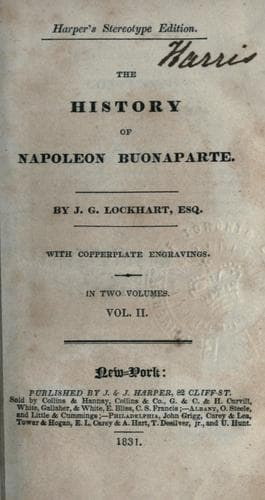
The History of Napoleon BuonaparteLockhart, J. G. (John Gibson)
History
The History of Napoleon Buonaparte
Lockhart, J. G. (John Gibson)
France -- Kings and rulers -- Biography; Napoleon I, Emperor of the French, 1769-1821
The establishment of the Confederation of the Rhine rendered Napoleon,
in effect, sovereign of a large part of Germany; and seemed to have so
totally revolutionised Central Europe, that Francis of Austria declared
the Imperial Constitution at an end. He retained the title of Emperor as
sovereign of his own hereditary dominions; but "The Holy Roman Empire,"
having lasted full one thousand years, was declared to be no more; and
of its ancient influence the representative was to be sought for not at
Vienna, but at Paris.
The vacillating court of Berlin heard with much apprehension of the
formation of the Rhenish confederacy;[53] and with deep resentment of
its immediate consequence, the dissolution of the Germanic Empire. The
house of Brandenburg had consented to the humiliation of Francis in the
hope of succeeding, at the next election, to the imperial crown so long
worn by the princes of Austria; and now, not only was that
long-cherished hope for ever dispelled, but it appeared that Napoleon
had laid the foundation of a new system, under which the influence of
the house of Brandenburg must, in all probability, be overruled far more
effectually than it ever had been, of recent times, by the imperial
prerogative of Austria.
The only method of counteracting the consolidation of French power all
over Germany, seemed to be that of creating another confederacy in the
northern circles, capable of balancing the league of the Rhine. The
Elector of Saxony, however, perceived that Napoleon was not likely to
acquiesce in the realisation of this scheme; and his Minister at Berlin
continued to decline acceding to the Northern alliance. The Prince of
Hesse-Cassel took a similar view of the case; but acted with a degree of
vacillation worthy of the late conduct of Prussia herself, refusing on
the one hand to embrace the confederation proposed by the Cabinet of
Berlin, and yet declining, on the other, to form part of the Rhenish
league, to which effect Buonaparte had frequently and urgently invited
this elector. In the reluctance, however, of these princes, Prussia saw
nothing but the determination of Napoleon to suppress, in the beginning,
any such confederation of the Northern German States as had been
contemplated; and irritation and jealousy from day to day increased.
The relations of France and Prussia continued in this dubious state,
until the Cabinet of Berlin learned some particulars of a negotiation
between Napoleon and the English Government, which took place in the
summer of 1806.
Public-domain text, read in full here on John Shaqi.
Reviews
Reviews
No reviews yet
Be the first to share your thoughts on this work.
Elsewhere in the archive
Join the Discussion
Join the discussion
Sign in to leave a comment or review.
Sign InorCreate an account