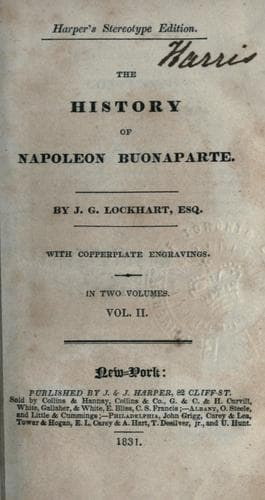
The History of Napoleon BuonaparteLockhart, J. G. (John Gibson)
History
The History of Napoleon Buonaparte
Lockhart, J. G. (John Gibson)
France -- Kings and rulers -- Biography; Napoleon I, Emperor of the French, 1769-1821
Mr. Pitt, who despaired of opposing Buonaparte on the continent after
Marengo, did not long survive the disastrous intelligence of Austerlitz.
Worn out and broken by the endless anxieties of his situation, not even
the glorious tidings of Trafalgar could revive the sinking spirit of
this great minister. He died on the 23rd of January, 1806, and was
succeeded in the government by Mr. Fox, the same statesman who had,
throughout every variety of fortune, arraigned his conduct of the war as
imbecile and absurd, and who all along professed his belief that in the
original quarrel between Great Britain and revolutionised France, the
blame lay with his own country, and above all with Mr. Pitt.
The personal intercourse which took place between Fox and Napoleon,
during the peace of Amiens, has already been alluded to. It was
calculated to make all men regard the chances of a solid peace between
France and England as increased by the event which transferred the reins
of government, in the latter country, into the hands of the illustrious
opponent of Mr. Pitt. But the peculiar feelings of English politicians
have seldom been understood by foreigners--never more widely
misunderstood than by Buonaparte. When Fox visited him, as First Consul,
at the Tuileries, he complained that the English Government countenanced
the assassins who were plotting against his life. Mr. Fox, forgetting
all his party prejudice when the honour of his country was assailed,
answered in terms such as Napoleon's own military bluntness could not
have surpassed--"Clear your head of that nonsense." And now, in like
manner, Mr. Fox, once placed in the responsible management of his
country's interests, was found, not a little to the surprise and
disappointment of Napoleon, about as close and watchful a negotiator as
he could have had to deal with in Pitt himself. The English minister
employed on this occasion, first, Lord Yarmouth,[54] one of the
_detenus_ of 1803, and afterwards Lord Lauderdale. For some time strong
hopes of a satisfactory conclusion were entertained; but, in the end,
the negotiation broke up, on the absolute refusal of Napoleon to concede
Malta to England, unless England would permit him to conquer Sicily from
the unfortunate sovereign whose Italian Kingdom had already been
transferred to his brother Joseph. Mr. Fox was lost to his country in
September, 1806; and Napoleon ever afterwards maintained that, had that
great statesman lived, the negotiation would have been resumed, and
pushed to a successful close. Meantime, however, the diplomatic
intercourse of the Tuileries and St. James's was at an end, and the
course which the negotiation had taken transpired necessarily in
Parliament.
Public-domain text, read in full here on John Shaqi.
Reviews
Reviews
No reviews yet
Be the first to share your thoughts on this work.
Elsewhere in the archive
Join the Discussion
Join the discussion
Sign in to leave a comment or review.
Sign InorCreate an account