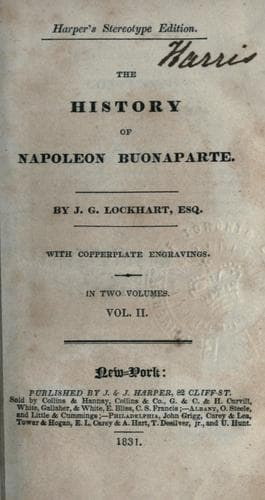
The History of Napoleon BuonaparteLockhart, J. G. (John Gibson)
History
The History of Napoleon Buonaparte
Lockhart, J. G. (John Gibson)
France -- Kings and rulers -- Biography; Napoleon I, Emperor of the French, 1769-1821
Soult had to sustain the first assault of the Prussians, which was
violent--and sudden; for the mist lay so thick on the field that the
armies were within half gunshot of each other ere the sun and wind rose
and discovered them; and on that instant Mollendorf charged. The battle
was contested well for some time on this point; but at length Ney
appeared in the rear of the Emperor with a fresh division; and then the
French centre advanced to a general charge, before which the Prussians
were forced to retire. They moved for some space in good order; but
Murat now poured his masses of cavalry on them, storm after storm, with
such rapidity and vehemence that their rout became inevitable. It ended
in the complete breaking up of the army--horse and foot all flying
together, in the confusion of panic, upon the road to Weimar. At that
point the fugitives met and mingled with their brethren flying, as
confusedly as themselves, from Auerstadt. In the course of this
disastrous day 20,000 Prussians were killed or taken; 300 guns, twenty
generals, and sixty standards. The Commander-in-Chief, the Duke of
Brunswick, being wounded in the face with a grape-shot, was carried
early off the field, never to recover. The loss of superior officers on
the Prussian side was so great, that of an army which, on the evening of
the 13th of October, mustered not less than 150,000, but a few regiments
were ever able to act in concert for some time after the 14th. The
various routed divisions roamed about the country, seeking separately
the means of escape: they were in consequence destined to fall an easy
prey. Mollendorf and the Prince of Orange-Fulda laid down their arms at
Erfurt. General Kalkreuth's corps was overtaken and surrounded among the
Hartz Mountains: Prince Eugene of Wirtemberg, and 16,000 men,
surrendered to Bernadotte at Halle. The Prince of Hohenlohe at length
drew together not less than 50,000 of these wandering soldiers, and
threw himself, at their head, into Magdeburg. But it turned out that
that great fortress had been stripped of all its stores for the service
of the Duke of Brunswick's army before Jena. Hohenlohe, therefore, was
compelled to retreat towards the Oder. He was defeated in a variety of
skirmishes; and at length, finding himself devoid of ammunition or
provisions, laid down his arms at Prenzlow; 20,000 surrendered with the
Prince. His rear, consisting of about 10,000, under the command of the
celebrated General Blucher, were so far behind as to render it possible
for them to attempt escape. Their heroic leader traversed the country
with them for some time unbroken, and sustained a variety of assaults,
from far superior numbers, with the most obstinate resolution. By
degrees, however, the French, under Soult, hemmed him in on one side,
Murat on the other, and Bernadotte appeared close behind him. He was
thus forced to throw himself into Lubeck, where a severe action was
fought in the streets of the town, on the 6th of November. The Prussian,
Public-domain text, read in full here on John Shaqi.
Reviews
Reviews
No reviews yet
Be the first to share your thoughts on this work.
Elsewhere in the archive
Join the Discussion
Join the discussion
Sign in to leave a comment or review.
Sign InorCreate an account