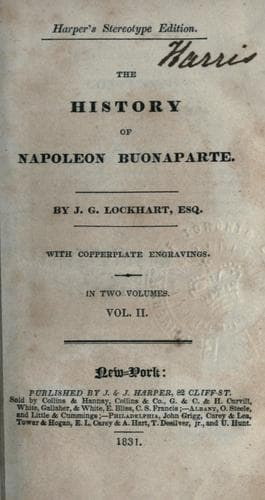
The History of Napoleon BuonaparteLockhart, J. G. (John Gibson)
History
The History of Napoleon Buonaparte
Lockhart, J. G. (John Gibson)
France -- Kings and rulers -- Biography; Napoleon I, Emperor of the French, 1769-1821
in this battle, lost 4000 prisoners, besides the slain and wounded: he
retreated to Schwerta, and there, it being impossible for him to go
farther without violating the neutrality of Denmark, on the morning of
the 7th, Blucher at length laid down his arms--having exhibited a
specimen of conduct and valour such as certainly had not been displayed
by any of his superiors in the campaign.
The strong fortresses of the Prussian monarchy made as ineffectual
resistance as the armies in the field. In how far the charge of actual
treachery, brought then, and still continued, against the commanders of
those places, be just, we know not; but the fact is certain that the
Governors of Spandau, Stettin, Custrin, Hamelen, and Magdeburg itself,
yielded successively to the French Generals, under circumstances which
roused the indignant suspicion of the Prussian people, as well as the
soldiery and their unfortunate King. Buonaparte, in person, entered
Berlin on the 25th of October: and before the end of November, except
Konigsberg--where the King himself had found refuge, and gathered round
him a few thousand troops, the sad relics of an army which had been
considered as not unable to withstand the whole power of France,--and a
few less important fortresses, the whole of the German possessions of
the house of Brandenburg were in the hands of the conqueror. Louis
Buonaparte, King of Holland, meanwhile, had advanced into Westphalia,
and occupied that territory also, with great part of Hanover, East
Friesland, Embden, and the dominions of Hesse-Cassel.
Public-domain text, read in full here on John Shaqi.
Reviews
Reviews
No reviews yet
Be the first to share your thoughts on this work.
Elsewhere in the archive
Join the Discussion
Join the discussion
Sign in to leave a comment or review.
Sign InorCreate an account