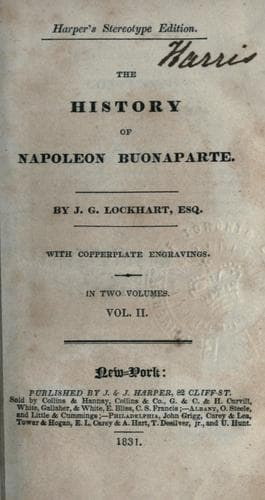
The History of Napoleon BuonaparteLockhart, J. G. (John Gibson)
History
The History of Napoleon Buonaparte
Lockhart, J. G. (John Gibson)
France -- Kings and rulers -- Biography; Napoleon I, Emperor of the French, 1769-1821
In the confusion of so great a movement, a division designed by
Bennigsen to occupy the town itself, misunderstood the order, and
evacuated it at the approach of the enemy's van. The French took
possession of the place accordingly, and--General Bennigsen commanding
it to be regained, as soon as he learned the mistake that had
occurred--the whole day was spent in severe fighting within the town,
which was taken and retaken several times, and at the fall of night
remained in the hands of the French. On either side the loss had been
very great, and Napoleon coming up in person, perceived that the contest
must needs be renewed at daybreak. The night was clear, and he could
trace the enemy's line darkening the whole of an admirably selected
position, between which and the dearly contested town, a level space
covered with snow, and two or three small frozen lakes, glittered in the
mingled light of an unclouded moon and innumerable watch-fires.
The great battle of PREUSS-EYLAU was fought on the 8th of February. At
dawn of day the French charged at two different points in strong
columns, and were unable to shake the iron steadiness of the infantry,
while the Russian horse, and especially the Cossacks under their gallant
Hetman Platoff, made fearful execution on each division, as successively
they drew back from their vain attempt. A fierce storm arose at mid-day:
the snow drifted right in the eyes of the Russians; the village of
Serpallen, on their left, caught fire, and the smoke also rolled dense
upon them. Davoust skilfully availed himself of the opportunity, and
turned their flank so rapidly, that Serpallen was lost, and the left
wing compelled to wheel backwards so as to form almost at right angles
with the rest of the line. The Prussian corps of L'Estocq, a small but
determined fragment of the campaign of Jena, appeared at this critical
moment in the rear of the Russian left; and, charging with such
gallantry as had in former times been expected from the soldiery of the
Great Frederick, drove back Davoust and restored the Russian line. The
action continued for many hours along the whole line--the French
attacked boldly, the Russians driving them back with unfailing
resolution. Ney, and a fresh division, at length came up, and succeeded
in occupying the village of Schloditten, on the road to Konigsberg. To
regain this, and thereby recover the means of communicating with the
King of Prussia, was deemed necessary; and it was carried accordingly at
the point of the bayonet. This was at ten o'clock at night. So ended the
longest and by far the severest battle in which Buonaparte had as yet
been engaged. The French are supposed to have had 90,000 men under arms
at its commencement; the Russians not more than 60,000. After fourteen
hours of fighting, either army occupied the same position as in the
morning. Twelve of Napoleon's eagles were in the hands of Bennigsen, and
the field between was covered with 50,000 corpses, of whom at least half
Public-domain text, read in full here on John Shaqi.
Reviews
Reviews
No reviews yet
Be the first to share your thoughts on this work.
Elsewhere in the archive
Join the Discussion
Join the discussion
Sign in to leave a comment or review.
Sign InorCreate an account