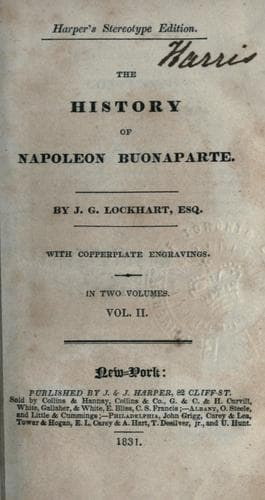
The History of Napoleon BuonaparteLockhart, J. G. (John Gibson)
History
The History of Napoleon Buonaparte
Lockhart, J. G. (John Gibson)
France -- Kings and rulers -- Biography; Napoleon I, Emperor of the French, 1769-1821
were French.
Either leader claimed the victory; Bennigsen exhibiting as proof of his
success the twelve eagles which his army, admitted to be inferior in
numbers, bore off the field: Buonaparte, that he kept possession of the
field, while the enemy retired, the very night after the battle, from
Eylau towards Konigsberg. It was, in truth, a drawn battle; and to have
found an equal was sufficient bitterness to Napoleon. The Russian
general-in-chief had retreated, in opposition to the opinion of most of
his council, out of anxiety for the personal safety of the King of
Prussia at Konigsberg, and desire to recruit his army ere another great
action should be hazarded. The French, triumphant as was the language of
their bulletins, made no effort to pursue. Bennigsen conducted his army
in perfect order to Konigsberg, and the Cossacks issuing from that city
continued for more than a week to waste the country according to their
pleasure, without any show of opposition from the French. But the best
proof how severely Napoleon had felt the struggle of Preuss-Eylau, is to
be found in a communication which he made to Frederick William, on the
13th of February, five days after the battle, offering him, in effect,
the complete, or nearly complete restoration of his dominions, provided
he would accept of a separate peace: with the king's answer; namely,
that it was impossible for him to enter on any treaty unless the Czar
were a party in it. Finally, on the 19th of February, Napoleon left
Eylau, and retreated with his whole army on the Vistula; satisfied that
it would be fatal rashness to engage in another campaign in Poland,
while several fortified towns, and, above all, Dantzick, held out in his
rear; and determined to have possession of these places, and to summon
new forces from France, ere he should again meet in the field such an
enemy as the Russian had proved to be.
Public-domain text, read in full here on John Shaqi.
Reviews
Reviews
No reviews yet
Be the first to share your thoughts on this work.
Elsewhere in the archive
Join the Discussion
Join the discussion
Sign in to leave a comment or review.
Sign InorCreate an account