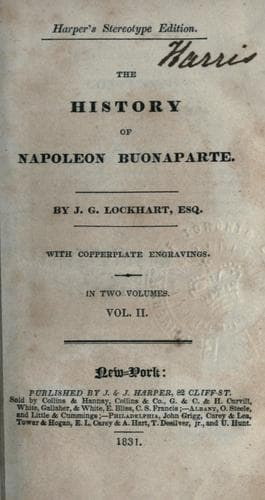
The History of Napoleon BuonaparteLockhart, J. G. (John Gibson)
History
The History of Napoleon Buonaparte
Lockhart, J. G. (John Gibson)
France -- Kings and rulers -- Biography; Napoleon I, Emperor of the French, 1769-1821
On the assumption of the Imperial dignity by Napoleon, the Ottoman
Porte, dazzled by the apparently irresistible splendour of his fate,
sent an embassy to congratulate him; and in effect the ancient alliance
between France and Turkey was re-established. Napoleon consequently had
little difficulty in procuring from Constantinople a declaration of war
against Russia, the great hereditary enemy of the Turk, at the time when
he was about to encounter the armies of the Czar in Poland. The
Dardanelles were shut against Russian vessels; and the English
government, considering this as sufficient evidence that the Grand
Seignior was attaching himself to the Antibritannic Confederacy,
despatched a squadron of ships under Admiral Duckworth, in February,
1807, with orders to force the passage of the Dardanelles, present
themselves before Constantinople, and demand from the Porte the custody
_pro tempore_ of all her ships of war. The Turks negotiated for a week
upon this proposal, but in the meantime increased and manned their
fortifications, under the direction of French engineers, with such
skill, that the English admiral began to be seriously alarmed for his
own safety; and at length, on the 1st of March, effected his retreat
through the Straits with considerable loss--this disgrace being the only
result of his expedition. On the 20th of the same month (of March, 1807)
another English expedition under General Fraser, having sailed from
Sicily to Egypt, took possession of Alexandria. But every subsequent
step they took proved unfortunate: after severe loss the English were
compelled to enter into a convention with the Turks, and wholly evacuate
Egypt on the 20th of September.
In January, 1807, an English expedition landed near Montevideo, and
carried that city by assault. Sir Home Popham, the admiral, was
recalled, and tried by a court-martial, on the ground that he had
undertaken this warfare without due authority; but he escaped with a
reprimand, and new reinforcements were sent out, first under General
Crawford, and secondly under General Whitelocke. The last-named officer
invested Buenos Ayres, and commanded a general assault of that town on
the 5th of July; on which occasion, notwithstanding the excellent
behaviour of the soldiery, he was repulsed with a loss of 2000 killed,
wounded, and prisoners; and reduced to such extremity, that he was soon
afterwards glad to enter into a convention, and wholly withdraw the
armament. The timid and incompetent Whitelocke was tried and cashiered.
Some of these disasters were unknown at the time when Bennigsen demanded
an armistice; but the general ill success of the British expeditions was
notorious, and produced without doubt a very serious impression on the
mind of Alexander.
Public-domain text, read in full here on John Shaqi.
Reviews
Reviews
No reviews yet
Be the first to share your thoughts on this work.
Elsewhere in the archive
Join the Discussion
Join the discussion
Sign in to leave a comment or review.
Sign InorCreate an account