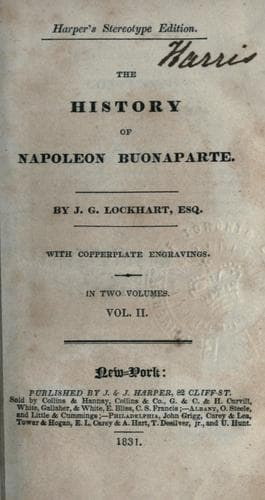
The History of Napoleon BuonaparteLockhart, J. G. (John Gibson)
History
The History of Napoleon Buonaparte
Lockhart, J. G. (John Gibson)
France -- Kings and rulers -- Biography; Napoleon I, Emperor of the French, 1769-1821
The armistice was ratified on the 23rd of June, and on the 25th the
Emperors of France and Russia met personally, each accompanied by a few
attendants, on a raft moored on the river Niemen, near the town of
Tilsit. The sovereigns embraced each other, and retiring under a canopy
had a long conversation, to which no one was a witness. At its
termination the appearances of mutual goodwill and confidence were
marked: immediately afterwards the town of Tilsit was neutralised, and
the two Emperors established their courts there, and lived together, in
the midst of the lately hostile armies, more like old friends who had
met on a party of pleasure, than enemies and rivals attempting by
diplomatic means the arrangement of differences which had for years been
deluging Europe with blood. Whatever flatteries could be suggested by
the consummate genius and mature experience of Napoleon, were lavished,
and produced their natural effects, on the mind of a young autocrat, of
great ambition, and as great vanity. The intercourse of the Emperors
assumed by degrees the appearance of a brotherlike intimacy. They spent
their mornings in reviewing each other's troops, or in unattended rides;
their evenings seemed to be devoted to the pleasures of the table, the
spectacle, music, dancing and gallantry. Meanwhile the terms of a future
alliance were in effect discussed, and settled much more rapidly than
could have been expected from any of the usual apparatus of diplomatic
negotiation.
The unfortunate King of Prussia was invited to appear at Tilsit; but,
complying with this invitation, was admitted to no share of the intimacy
of Napoleon. The conqueror studiously, and on every occasion, marked the
difference between his sentiments respecting this prince and the young
and powerful sovereign, for whose sake alone any shadow of royalty was
to be conceded to the fallen house of Brandenburg. The beautiful and
fascinating queen also arrived at Tilsit; but she was treated even more
coldly and harshly than her husband. Involuntary tears rushed from her
eyes as she submitted to the contemptuous civilities of Napoleon. His
behaviour to this admirable person rekindled with new fervour the wrath
and hatred of every Prussian bosom; and her death, following soon
afterwards, and universally attributed to the cruel laceration which all
her feelings as a woman and a queen had undergone, was treasured as a
last injury, demanding, at whatever hazard, a terrible expiation.
Public-domain text, read in full here on John Shaqi.
Reviews
Reviews
No reviews yet
Be the first to share your thoughts on this work.
Elsewhere in the archive
Join the Discussion
Join the discussion
Sign in to leave a comment or review.
Sign InorCreate an account