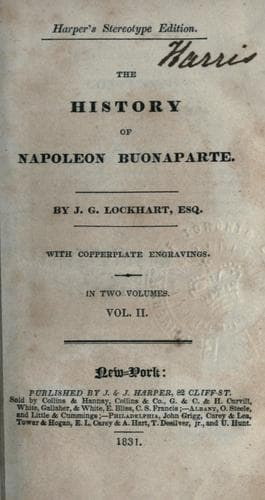
The History of Napoleon BuonaparteLockhart, J. G. (John Gibson)
History
The History of Napoleon Buonaparte
Lockhart, J. G. (John Gibson)
France -- Kings and rulers -- Biography; Napoleon I, Emperor of the French, 1769-1821
The result of his exertions was the complete assurance of the government
of St. James's, that the Emperor of Russia had adopted the alliance of
Napoleon to an extent far beyond what appeared on the face of the treaty
of the 7th July; that he had agreed not only to lay English commerce, in
case his mediation for a peace should fail, under the same ban with that
of the decrees of Berlin, but to place himself at the head of a general
confederation of the Northern Maritime Powers against the naval
supremacy of England--in other words, resign his own fleets, with those
of Denmark, to the service of Napoleon. In requital of this obligation
the French Emperor unquestionably agreed to permit the Czar to conquer
Finland from Sweden--thereby adding immeasurably to the security of St.
Petersburg. On the other hand it is almost as impossible to doubt that
Alexander pledged himself not to interfere with those ambitious designs
as to the Spanish Peninsula, which Napoleon was ere long to develop, and
which were destined ultimately to work his ruin.
In a word, there seems to be little doubt that Napoleon broached at
Tilsit the dazzling scheme of dividing the European world virtually
between the two great monarchs of France and Russia: and that the Czar,
provided he were willing to look on, while his Imperial brother of the
West subjected Spain, Portugal and England to his yoke, was induced to
count on equal forbearance, whatever schemes he might venture on for his
own aggrandisement, at the expense of the smaller states of the North of
Europe, and, above all, of the Ottoman Porte.
[Footnote 56: Kosciusko himself subsequently disavowed any knowledge of
the production.]
[Footnote 57: Afterwards first Earl Granville.]
CHAPTER XXII
British Expedition to Copenhagen--Coalition of France, Austria,
Prussia, and Russia, against English Commerce--Internal affairs of
France--The Administration of Napoleon--his Council of
State--Court--Code--Public Works--Manufactures--Taxes--Military
Organisation--The Conscription.
Napoleon, having left strong garrisons in the maritime cities of Poland
and Northern Germany, returned to Paris in August, and was received by
the Senate and other public bodies with all the triumph and excess of
adulation. The Swedish King abandoned Pomerania immediately on hearing
of the treaty of Tilsit. In effect the authority of the Emperor appeared
now to be consolidated over the whole continent of Europe. He had
reached indeed the pinnacle of his power and pride;--henceforth he was
to descend; urged downwards, step by step, by the reckless audacity of
ambition and the gathering weight of guilt.
Public-domain text, read in full here on John Shaqi.
Reviews
Reviews
No reviews yet
Be the first to share your thoughts on this work.
Elsewhere in the archive
Join the Discussion
Join the discussion
Sign in to leave a comment or review.
Sign InorCreate an account