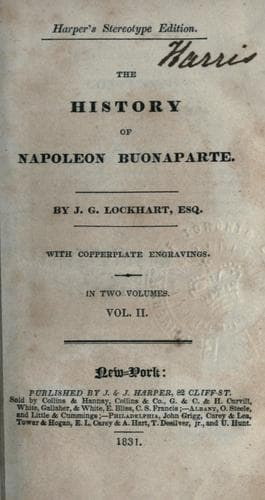
The History of Napoleon BuonaparteLockhart, J. G. (John Gibson)
History
The History of Napoleon Buonaparte
Lockhart, J. G. (John Gibson)
France -- Kings and rulers -- Biography; Napoleon I, Emperor of the French, 1769-1821
The Treaty of Tilsit, to which, as the document itself bore testimony,
the King of Prussia was admitted as a party solely by reason of
Napoleon's "esteem for the Emperor of Russia," was ratified on the 7th
July. Napoleon restored, by this act, to Frederick William, Ancient
Prussia, and the French conquests in Upper Saxony--the King agreeing to
adopt "the continental system," in other words, to be henceforth the
vassal of the conqueror. The Polish provinces of Prussia were erected
into a separate principality, styled "the Grand Duchy of Warsaw," and
bestowed on the Elector of Saxony; with the exception, however, of some
territories assigned to Russia, and of Dantzick, which was declared a
free city, to be garrisoned by French troops until the ratification of a
maritime peace. The Prussian dominions in Lower Saxony and on the Rhine,
with Hanover, Hesse-Cassel, and various other small states, formed a new
kingdom of Westphalia, of which Jerome Buonaparte, Napoleon's youngest
brother, was recognised as King; Jerome having at length made his peace
with his brother by repudiating his wife, an American lady of the name
of Patterson, and consenting to a new alliance, more consonant with the
views of the Emperor, with a daughter of the King of Wirtemberg. The
Elector of Saxony was recognised as another _King_ of Napoleon's
creation; Joseph Buonaparte as King of Naples; and Louis, of Holland.
Finally, Russia accepted the mediation of France for a peace with
Turkey, and France that of Russia for a peace with England.
Such were the public articles of the peace of Tilsit; but it contained
secret articles besides; and of these the English government were, ere
long, fortunate enough to ascertain the import.
The British cabinet had undergone a complete change in March, 1807--the
management of affairs passing from the friends and heirs of Mr. Fox into
the hands of Mr. Perceval and other statesmen of the school of Pitt. The
unhappy conduct of the war had rendered the preceding government
eminently unpopular; and the measures of the new one assumed from the
beginning a character of greater energy. But the orders which had been
given must be fulfilled; and the councils of 1806 bequeathed a fatal
legacy in the disastrous expeditions of 1807. Lord Granville Leveson
Gower[57] (the minister at St. Petersburg) was ere this time prepared to
offer to the Czar such subsidies as he had in vain expected when
preparing for the campaign of Poland; but it was too late to retrieve
the error of the preceding cabinet; and the English ambassador, being
unable to break off the negotiations at Tilsit, was compelled to bestow
all his efforts on penetrating the secrets of the compact wherein they
ended.
Public-domain text, read in full here on John Shaqi.
Reviews
Reviews
No reviews yet
Be the first to share your thoughts on this work.
Elsewhere in the archive
Join the Discussion
Join the discussion
Sign in to leave a comment or review.
Sign InorCreate an account