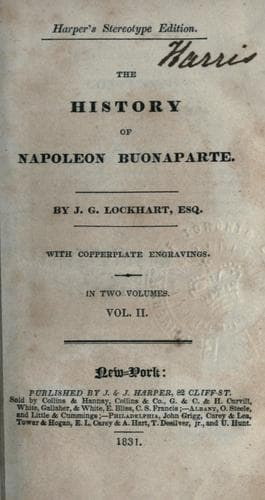
The History of Napoleon BuonaparteLockhart, J. G. (John Gibson)
History
The History of Napoleon Buonaparte
Lockhart, J. G. (John Gibson)
France -- Kings and rulers -- Biography; Napoleon I, Emperor of the French, 1769-1821
He perceived that the time was come for turning a new leaf in the
history of war. With such numbers of troops as the infant Republic could
afford him, he saw that no considerable advantages could be obtained
against the vast and highly-disciplined armies of Austria and her
allies, unless the established rules and etiquettes of strategy were
abandoned. It was only by such rapidity of motion as should utterly
transcend the suspicion of his adversaries, that he could hope to
concentrate the whole pith and energy of a small force upon some one
point of a much greater force opposed to it, and thus _rob_ them
(according to his own favourite phrase) of the victory. To effect such
rapid marches, it was necessary that the soldiery should make up their
minds to consider tents and baggage as idle luxuries; and that, instead
of a long and complicated chain of reserves and stores, they should dare
to rely wholly for the means of subsistence on the resources of the
countries into which their leader might conduct them. They must be
contented to conquer at whatever hazard; to consider no sacrifices or
hardships as worthy of a thought. The risk of destroying the character
and discipline of the men, by accustoming them to pillage, was obvious.
Buonaparte trusted to victory, the high natural spirit of the nation,
and the influence of his own genius, for the means of avoiding this
danger; and many years, it must be admitted, elapsed, before he found
much reason personally to repent of the system which he adopted. Against
the enemies of the Republic its success was splendid, even beyond his
hopes.
The objects of the approaching expedition were three: first, to compel
the King of Sardinia, who had already lost Savoy and Nice, but still
maintained a powerful army on the frontiers of Piedmont, to abandon the
alliance of Austria: secondly, to compel the Emperor, by a bold invasion
of Lombardy, to make such exertions in that quarter as might weaken
those armies which had so long hovered on the Rhine; and, if possible,
to stir up the Italian subjects of that crown to adopt the revolutionary
system and emancipate themselves for ever from its yoke. The third
object, though more distant, was not less important. The influence of
the Romish Church was considered by the Directory as the chief, though
secret, support of the cause of royalism within their own territory; and
to reduce the Vatican into insignificance, or at least force it to
submission and quiescence, appeared indispensable to the internal
tranquillity of France. The Revolutionary Government, besides this
general cause of hatred and suspicion, had a distinct injury to avenge.
Their agent, Basseville, had three years before been assassinated in a
popular tumult at Rome: the Papal troops had not interfered to protect
him, nor the Pope to punish his murderers; and the haughty Republic
considered this as an insult which could only be washed out with a sea
of blood.
Public-domain text, read in full here on John Shaqi.
Reviews
Reviews
No reviews yet
Be the first to share your thoughts on this work.
Join the Discussion
Join the discussion
Sign in to leave a comment or review.
Sign InorCreate an account