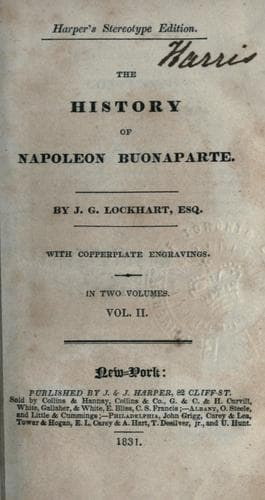
The History of Napoleon BuonaparteLockhart, J. G. (John Gibson)
History
The History of Napoleon Buonaparte
Lockhart, J. G. (John Gibson)
France -- Kings and rulers -- Biography; Napoleon I, Emperor of the French, 1769-1821
There are authors who still delight to undervalue the motives of this
great national movement; according to whom the commercial classes rose
chiefly, if not solely, from their resentment of the pecuniary losses
inflicted on them by Godoy's alliance with the author of the
"continental system"; the priesthood because Godoy had impoverished the
church, and they feared that a Buonapartean government would pursue the
same course to a much greater extent; the peasantry because their
priests commanded them. All these influences unquestionably operated,
and all strongly; but who can believe in the absence of others
infinitely above these, and common to all the Spaniards who, during six
years, fought and bled, and saw their towns ruined and their soil a
waste, that they might vindicate their birthright, the independence of
their nation? Nor can similar praise be refused to the great majority of
the Portuguese. Napoleon summoned a body of the nobles of that kingdom
also to meet him early in the year at Bayonne: they obeyed, and being
addressed by the haughty usurper in person, resisted all his efforts to
cajole them into an imitation of the Spanish Notables, who at the same
time and place accepted Joseph for their King. They were in consequence
retained as prisoners in France during the war which followed; but their
fate operated as a new stimulus upon the general feeling of their
countrymen at home, already well prepared for insurrection by the brutal
oppression of Junot.
The Spanish arms were at first exposed to many reverses; the rawness of
their levies, and the insulated nature of their movements, being
disadvantages of which it was not difficult for the experienced Generals
and overpowering numbers of the French to reap a full and bloody
harvest. After various petty skirmishes, in which the insurgents of
Arragon were worsted by Lefebre Desnouettes, and those of Navarre and
Biscay by Bessieres, the latter officer came upon the united armies of
Castile, Leon and Galicia, commanded by the Generals Cuesta and Blake,
on the 14th of July, at Riosecco, and defeated them in a desperate
action, in which not less than 20,000 Spaniards died. This calamitous
battle it was which opened the gates of Madrid to the intrusive
king--whose arrival in that capital on the 20th of the same month has
already been mentioned.
Public-domain text, read in full here on John Shaqi.
Reviews
Reviews
No reviews yet
Be the first to share your thoughts on this work.
Elsewhere in the archive
Join the Discussion
Join the discussion
Sign in to leave a comment or review.
Sign InorCreate an account