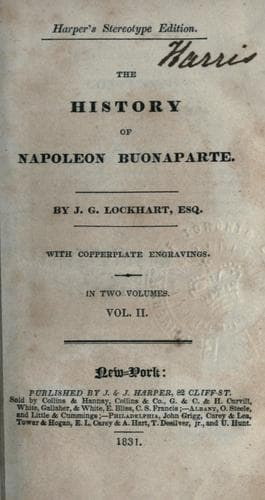
The History of Napoleon BuonaparteLockhart, J. G. (John Gibson)
History
The History of Napoleon Buonaparte
Lockhart, J. G. (John Gibson)
France -- Kings and rulers -- Biography; Napoleon I, Emperor of the French, 1769-1821
But Joseph was not destined to remain long in Madrid: the fortune of
war, after the great day of Riosecco, was everywhere on the side of the
patriots. Duhesme, who had so treacherously possessed himself of
Barcelona and Figueras, found himself surrounded by the Catalonian
mountaineers, who, after various affairs, in which much blood was shed
on both sides, compelled him to shut himself up in Barcelona. Marshal
Moncey conducted another large division of the French towards Valencia,
and was to have been further reinforced by a detachment from Duhesme.
The course of events in Catalonia prevented Duhesme from affording any
such assistance; and the inhabitants of Valencia, male and female,
rising _en masse_, and headed by their clergy, manned their walls with
such determined resolution, that the French marshal was at length
compelled to retreat. He fell back upon the main body, under Bessieres,
but did not effect a conjunction with them until his troops had suffered
miserably in their march through an extensive district, in which every
inhabitant was a watchful enemy.
A far more signal catastrophe had befallen another powerful _corps
d'armée_, under General Dupont, which marched from Madrid towards the
south, with the view of suppressing all symptoms of insurrection in that
quarter, and, especially, of securing the great naval station of Cadiz,
where a French squadron lay, watched, as usual, by the English. Dupont's
force was increased as he advanced, till it amounted to 20,000 men; and
with these he took possession of Baylen and La Carolina, in Andalusia,
and stormed Jaen. But before he could make these acquisitions, the
citizens of Cadiz had universally taken the patriot side; the commander
of the French vessels had been forced to surrender them; and the place,
having opened a communication with the English fleet, assumed a posture
of determined defence. General Castaños, the Spanish commander in that
province, meanwhile, having held back from battle until his raw troops
should have had time to be disciplined, began at length to threaten the
position of the French. Jaen was attacked by him with such vigour, that
Dupont was fain to evacuate it, and fall back to Baylen, where his
troops soon suffered severe privations, the peasantry being in arms all
around them, and the supply of food becoming from day to day more
difficult. On the 16th of July, Dupont was attacked at Baylen by
Castaños, who knew from an intercepted despatch the extent of his
enemy's distress: the French were beaten, and driven as far as Menjibar.
They returned on the 18th, and attempted to recover Baylen; but, after a
long and desperate battle, in which 3000 of the French were killed,
Dupont, perceiving that the Spaniards were gathering all around in
numbers not to be resisted, proposed to capitulate. In effect, he and
20,000 soldiers laid down their arms at Baylen, on condition that they
should be transported in safety into France. The Spaniards broke this
Public-domain text, read in full here on John Shaqi.
Reviews
Reviews
No reviews yet
Be the first to share your thoughts on this work.
Elsewhere in the archive
Join the Discussion
Join the discussion
Sign in to leave a comment or review.
Sign InorCreate an account