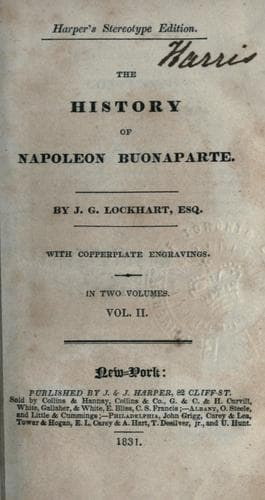
The History of Napoleon BuonaparteLockhart, J. G. (John Gibson)
History
The History of Napoleon Buonaparte
Lockhart, J. G. (John Gibson)
France -- Kings and rulers -- Biography; Napoleon I, Emperor of the French, 1769-1821
Napoleon should be able to send him additional forces from Spain.
Meanwhile Portugal was free from the presence of her enemies; England
had obtained a permanent footing within the Peninsula; what was of still
higher moment, the character of the British army was raised not only
abroad, but at home; and had the two insurgent nations availed
themselves, as they ought to have done, of the resources which their
great ally placed at their command, and conducted their own affairs with
unity and strength of purpose, the deliverance of the whole peninsula
might have been achieved years before that consummation actually took
place.
The Portuguese, however, split into factions--under leaders whose
primary objects were selfish, who rivalled each other in their absurd
jealousy of England, afforded to her troops no such supplies and
facilities as they had the best title to demand and expect, and wasted
their time in petty political intrigues, instead of devoting every
energy to the organisation of an efficient army, and improving the
defences of their naturally strong frontier. The Spaniards conducted
themselves with even more signal imprudence. For months each provincial
junta seemed to prefer the continuance of its own authority to the
obvious necessity of merging all their powers in some central body,
capable of controlling and directing the whole force of the nation; and
after a supreme junta was at last established in Madrid, its orders were
continually disputed and disobeyed--so that in effect there was no
national government. Equally disgraceful jealousies among the generals
prevented the armies from being placed under one supreme chief,
responsible for the combination of all their movements. In place of this
it was with difficulty that the various independent generals could be
prevailed on even to meet at Madrid, and agree to the outline of a joint
campaign; and that outline seemed to have no recommendation except that
its gross military defects held out to each member of the Council the
prospect of being able to act without communication, for good or for
evil, with any of the others. The consequences of these shameful follies
were calamitous: and but for events which could not have been foreseen,
must have proved fatal: for the gigantic resources of the common enemy
were about to be set in motion by Napoleon himself; who, on hearing of
the reverses of Dupont, Lefebre, and Junot, perceived too clearly that
the affairs of the Peninsula demanded a keener eye and a firmer hand
than his brother's.
[Footnote 59: Col. Napier, chap. i.]
CHAPTER XXV
Napoleon at Erfurt--At Paris--Arrives at Vittoria--Disposition of
the French and Spanish Armies--Successes of Soult--Passage of the
Somosierra--Surrender of Madrid--Sir John Moore's Campaign--his
Retreat--Battle of Coruña--Death of Moore--Napoleon leaves Spain.
Public-domain text, read in full here on John Shaqi.
Reviews
Reviews
No reviews yet
Be the first to share your thoughts on this work.
Elsewhere in the archive
Join the Discussion
Join the discussion
Sign in to leave a comment or review.
Sign InorCreate an account