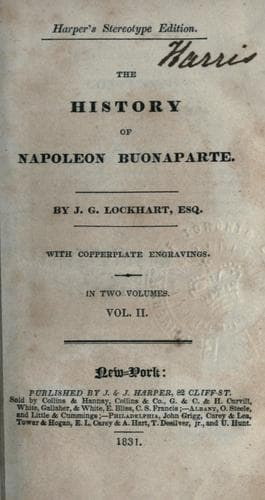
The History of Napoleon BuonaparteLockhart, J. G. (John Gibson)
History
The History of Napoleon Buonaparte
Lockhart, J. G. (John Gibson)
France -- Kings and rulers -- Biography; Napoleon I, Emperor of the French, 1769-1821
This retreat would not have been accomplished without much more
fighting, had Sir Arthur Wellesley been permitted to follow up his
victory, according to the dictates of his own understanding and the
enthusiastic wishes of his army. But just as the battle was about to
begin, Sir Harry Burrard, an old officer of superior rank, unfortunately
entitled to assume the chief command, arrived on the field. Finding that
Sir Arthur had made all his dispositions, General Burrard handsomely
declined interfering until the fortune of the day should be decided; but
he took the command as soon as the victory was won, and more cautiously
than wisely, prevented the army from instantly advancing, as Sir Arthur
Wellesley proposed, upon the coast road towards Mafra, and thus
endeavouring to intercept the retreat of Junot upon Lisbon. Sir Harry,
having made this unhappy use of his command, was, the very next day,
superseded in his turn by Sir Hew Dalrymple, the Governor of Gibraltar;
another veteran more disposed to imitate the prudence of Burrard than
the daring of Wellesley.
Shortly after the third general had taken the command, Junot sent
Kellerman to demand a truce, and propose a convention for the evacuation
of Portugal by the troops under his orders. Dalrymple received Kellerman
with more eagerness of civility than became the chief of a victorious
army, and forthwith granted the desired armistice. Junot offered to
surrender his magazine, stores, and armed vessels, provided the British
would disembark his soldiers, with their arms, at any French port
between Rochefort and L'Orient, and permit them to take with them their
private property; and Dalrymple did not hesitate to agree to these
terms, although Sir John Moore arrived off the coast with a
reinforcement of 10,000 men during the progress of the negotiation. The
famous "_Convention of Cintra_" (most absurdly so named, as it was in
fact concluded thirty miles from Cintra) was signed accordingly on the
30th of August; and the French army wholly evacuated Portugal in the
manner provided for. The English people heard with indignation that the
spoilers of Portugal had been suffered to escape on such terms; and the
article concerning private property gave especial offence, as under that
cover the French removed with them a large share of the plunder which
they had amassed by merciless violence and rapacity during their
occupation of the Portuguese territories. A parliamentary investigation
was followed by a court-martial, which acquitted Dalrymple. In truth it
seems now to be admitted, by competent judges, that after Burrard had
interfered so as to prevent Wellesley from instantly following up the
success of Vimiero, and so enabled Junot to re-occupy Lisbon and secure
the pass of the Torres Vedras, it would have been imprudent to decline
the terms proffered by a repelled, but still powerful enemy--who, if
driven to extremities, could hardly fail to prolong the war, until
Public-domain text, read in full here on John Shaqi.
Reviews
Reviews
No reviews yet
Be the first to share your thoughts on this work.
Elsewhere in the archive
Join the Discussion
Join the discussion
Sign in to leave a comment or review.
Sign InorCreate an account