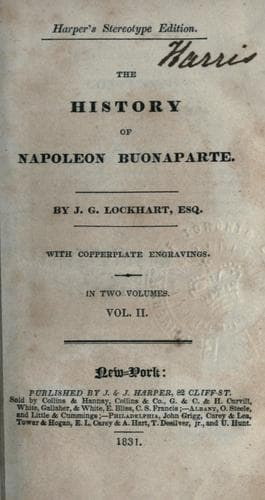
The History of Napoleon BuonaparteLockhart, J. G. (John Gibson)
History
The History of Napoleon Buonaparte
Lockhart, J. G. (John Gibson)
France -- Kings and rulers -- Biography; Napoleon I, Emperor of the French, 1769-1821
Having thus dismissed his troops on their way, Buonaparte himself
travelled rapidly to Erfurt, where he had invited the Emperor Alexander
to confer with him. It was most needful that before he went to Spain
himself, he should ascertain the safety of his empire on the other side;
and there was much in the state of Germany that might well give rise to
serious apprehensions. Austria was strengthening her military
establishment to a vast extent, and had, by a recent law, acquired the
means of drawing on her population unlimitedly, after the method of
Napoleon's own conscription code. She professed pacific intentions
towards France, and intimated that her preparations were designed for
the protection of her Turkish frontier; but the Emperor Francis
positively declined to acknowledge Joseph Buonaparte as King of Spain;
and this refusal was quite sufficient for Napoleon. In Prussia,
meantime, and indeed all over Germany, a spirit of deep and settled
enmity was manifesting itself in the shape of patriotic clubs (the chief
being called the _Tugend-bund_, or Alliance of Virtue), which included
the young and the daring of every class, and threatened, at no distant
period, to convulse the whole fabric of society with the one purpose of
clearing the national soil of its foreign oppressors. Napoleon affected
to deride, but secretly estimated at its true importance, the danger of
such associations, if permitted to take firm root among a people so
numerous, so enthusiastic, and so gallant. Lastly, there is every reason
to believe that, cordial as the Czar's friendship had seemed to be at
Tilsit, Buonaparte appreciated the unpopularity of his "continental
system" in Russia, and the power of the aristocracy there, far too
accurately, not to entertain some suspicion that Alexander himself might
be compelled to take the field against him, should England succeed in
persuading Austria and Germany to rise in arms during his own absence in
Spain. For these reasons he had requested the Czar's presence at Erfurt;
and this conference was apparently as satisfactory to either as that of
Tilsit had been. They addressed a joint letter to the King of England,
proposing once more a general peace; but as they both refused to
acknowledge any authority in Spain save that of King Joseph, the answer
was of course in the negative. Buonaparte, however, had obtained his
object when he thus exhibited the Czar and himself as firmly allied. He
perceived clearly that Austria was determined on another campaign; gave
orders for concentrating and increasing his own armies, accordingly,
both in Germany and Italy; and--trusting to the decision and rapidity of
his own movements, and the comparative slowness of his ancient
enemy--dared to judge that he might still bring matters to an issue in
Spain, before his presence should be absolutely necessary beyond the
Rhine.
Public-domain text, read in full here on John Shaqi.
Reviews
Reviews
No reviews yet
Be the first to share your thoughts on this work.
Elsewhere in the archive
Join the Discussion
Join the discussion
Sign in to leave a comment or review.
Sign InorCreate an account