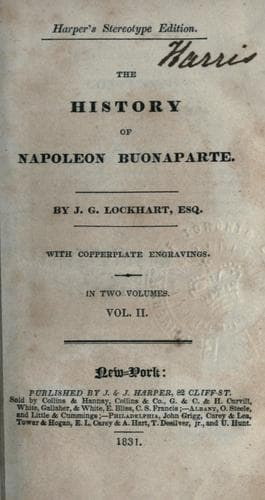
The History of Napoleon BuonaparteLockhart, J. G. (John Gibson)
History
The History of Napoleon Buonaparte
Lockhart, J. G. (John Gibson)
France -- Kings and rulers -- Biography; Napoleon I, Emperor of the French, 1769-1821
On the 14th of October the conferences of Erfurt terminated; on the 24th
Napoleon was present at the opening of the Legislative Session in Paris;
two days after he left that capital, and reached Bayonne on the 3rd of
November, where he remained, directing the movements of the last columns
of his advancing army, until the morning of the 8th. He arrived at
Vittoria the same evening: the civil and military authorities met him at
the gates of the town, and would have conducted him to a house prepared
for his reception, but he leapt from his horse, entered the first inn
that he observed, and calling for maps and a detailed report of the
position of all the armies, French and Spanish, proceeded instantly to
draw up his plan for the prosecution of the war. Within two hours he had
completed his task. Soult, who had accompanied him from Paris, and whom
he ordered to take the command of Bessieres' corps, set off on the
instant, reached Briviesca, where its headquarters were, at daybreak on
the 9th, and within a few hours the whole machinery was once more in
motion.
Napoleon had, early in October, signified to Joseph that the French
cause in Spain, would always be favoured by acting on the offensive, and
his disapproval of the extent to which the King had retreated had not
been heard in vain. General Blake's army had already been brought to
action, and defeated disastrously by Moncey, at Espinosa; from which
point Blake had most injudiciously retreated towards Reynosa, instead
of Burgos, where another army, meant to support his right, had assembled
under the orders of the Count de Belvedere.
Soult now poured down his columns on the plains of Burgos. Belvedere was
defeated by him at Gomenal even more easily than Blake had been at
Espinosa. The latter, again defeated by the indefatigable Soult, at
Reynosa, was obliged to take refuge, with what hardly could be called
even the skeleton of an army, in the seaport of St. Ander. Thus the
whole of the Spanish left was dissipated; and the French right remained
at liberty to march onwards at their pleasure.
Palafox meanwhile had effected at length a junction with Castaños; and
the combined Spanish armies of the centre and the east awaited the
French attack, on the 22nd of November, at Tudela. The disaster here was
still more complete. Castaños and Palafox separated in the moment of
overthrow; the former escaping to Calatayud with the wreck of his
troops, while the latter made his way once more to Zaragossa.
Public-domain text, read in full here on John Shaqi.
Reviews
Reviews
No reviews yet
Be the first to share your thoughts on this work.
Elsewhere in the archive
Join the Discussion
Join the discussion
Sign in to leave a comment or review.
Sign InorCreate an account