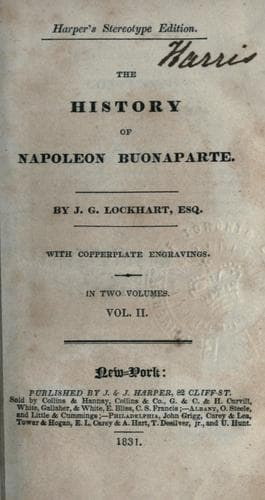
The History of Napoleon BuonaparteLockhart, J. G. (John Gibson)
History
The History of Napoleon Buonaparte
Lockhart, J. G. (John Gibson)
France -- Kings and rulers -- Biography; Napoleon I, Emperor of the French, 1769-1821
Napoleon now exercised all the rights of a conqueror. He issued edicts
abolishing the Inquisition, all feudal rights, and all particular
jurisdictions; regulating the number of monks; increasing, at the
expense of the monastic establishments, the stipends of the parochial
clergy; and proclaiming a general amnesty, with only _ten_ exceptions.
He received a deputation of the chief inhabitants, who came to signify
their desire to see Joseph among them again. His answer was, that Spain
was his own by right of conquest; that he could easily rule it by
viceroys; but that if they chose to assemble in their churches, priests
and people, and swear allegiance to Joseph, he was not indisposed to
listen to their request.
This was a secondary matter: meantime the Emperor was making his
dispositions for the completion of his conquest. His plan was to invade
forthwith Andalusia, Valencia and Galicia, by his lieutenants, and to
march in person to Lisbon. Nor was this vast plan beyond his means; for
he had at that moment 255,000 men, 50,000 horses, and 100 pieces of
field artillery, actually ready for immediate service in Spain: while
80,000 men and 100 cannon, besides, were in reserve, all on the south
side of the Pyrenees. To oppose this gigantic force there were a few
poor defeated corps of Spaniards, widely separated from each other, and
flying already before mere detachments: Seville, whose local junta had
once more assumed the nominal sovereignty, and guarded in front by a
feeble corps in the Sierra Morena; Valencia, without a regular garrison;
Zaragossa, closely invested, and resisting once more with heroic
determination; and the British army under Sir John Moore. The moment
Napoleon was informed that Moore had advanced into Spain, he abandoned
every other consideration, and resolved in person to march and overwhelm
him.
The English general had, as we have already seen, been prevented by
circumstances over which he could have no control, from commencing his
campaign so early as he desired, and as the situation of the Spanish
armies, whom he was meant to support, demanded. At length, however, he
put his troops, 20,000 in number, into motion, and advanced in the
direction of Salamanca; while a separate British corps of 13,000, under
Sir David Baird, recently landed at Coruña, had orders to march through
Galicia, and effect a junction with Moore either at Salamanca or
Valladolid. The object of the British was of course to support the
Spanish armies of Blake and Belvedere in their defence: but owing to the
delays and blundering intelligence already alluded to, these armies were
in a hopeless condition before Sir John Moore's march began.
Public-domain text, read in full here on John Shaqi.
Reviews
Reviews
No reviews yet
Be the first to share your thoughts on this work.
Elsewhere in the archive
Join the Discussion
Join the discussion
Sign in to leave a comment or review.
Sign InorCreate an account