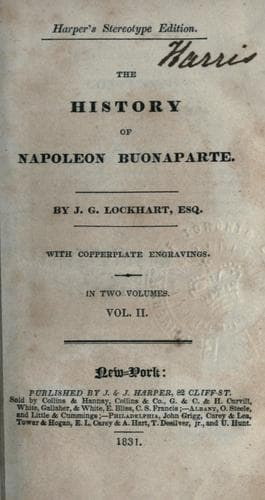
The History of Napoleon BuonaparteLockhart, J. G. (John Gibson)
History
The History of Napoleon Buonaparte
Lockhart, J. G. (John Gibson)
France -- Kings and rulers -- Biography; Napoleon I, Emperor of the French, 1769-1821
During eight days the inhabitants had been preparing the means of
resistance. A local and military junta had been invested with authority
to conduct the defence. Six thousand regular troops were in the town,
and crowds of the citizens and of the peasantry of the adjoining country
were in arms along with them. The pavement had been taken up, the
streets barricadoed, the houses on the outskirts loopholed, and the
Retiro, a large but weak edifice, occupied by a strong garrison.
Terrible violence prevailed--many persons suspected of adhering to the
side of the French were assassinated; the bells of churches and convents
rung incessantly; ferocious bands paraded the streets day and night: and
at the moment when the enemy's cavalry appeared, the universal uproar
seemed to announce that he was about to find a new and a greater
Zaragossa in Madrid.
The town was summoned at noon; and the officer employed would have been
massacred by the mob but for the interference of the Spanish regulars.
Napoleon waited until his infantry and artillery came up in the evening,
and then the place was invested on one side. "The night was clear and
bright" (says Napier); "the French camp was silent and watchful; but the
noise of tumult was heard from every quarter of the city, as if some
mighty beast was struggling and howling in the toils." At midnight the
city was again summoned; and the answer being still defiance, the
batteries began to open. In the course of the day the Retiro was
stormed, and the immense palace of the Dukes of Medina Celi, which
commands one side of the town, seized also. Terror now began to prevail
within; and shortly after the city was summoned, for the third time, Don
Thomas Morla, the governor, came out to demand a suspension of arms.
Napoleon received him with anger, and rebuked him for the violation of
the capitulation at Baylen. "Injustice and bad faith," said he, "always
recoil on those who are guilty of them." Many an honester Spaniard was
obliged to listen in silence to such words from the negotiator of
Fontainebleau and Bayonne.
Morla was a coward, and there is no doubt a traitor also. On returning
to the town he urged the necessity of instantly capitulating; and most
of those in authority took a similar part, except Castellas, the
commander of the regular troops. The peasantry and citizens kept firing
on the French outposts during the night; but Castellas, perceiving that
the civil rulers were all against further resistance, withdrew his
troops and sixteen cannon in safety. At eight in the morning of the 4th,
Madrid surrendered. The Spaniards were disarmed, and the town filled
with the French army. Napoleon took up his residence at Chamartin, a
country house four miles off. In a few days tranquillity seemed
completely re-established. The French soldiery observed excellent
discipline: the shops were re-opened, and the theatres frequented as
usual. Such is in most cases the enthusiasm of a great city!
Public-domain text, read in full here on John Shaqi.
Reviews
Reviews
No reviews yet
Be the first to share your thoughts on this work.
Elsewhere in the archive
Join the Discussion
Join the discussion
Sign in to leave a comment or review.
Sign InorCreate an account