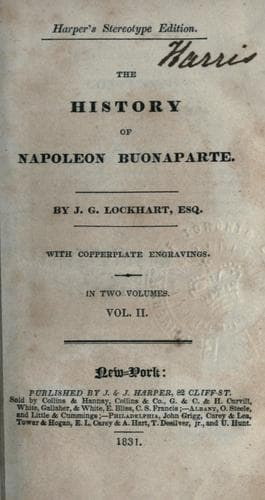
The History of Napoleon BuonaparteLockhart, J. G. (John Gibson)
History
The History of Napoleon Buonaparte
Lockhart, J. G. (John Gibson)
France -- Kings and rulers -- Biography; Napoleon I, Emperor of the French, 1769-1821
Thus, in five days, in spite of inferiority of numbers, and of the
unfavourable manner in which his lieutenants had distributed an inferior
force, by the sole energy of his genius did the Emperor triumph over the
main force of his opponent.
He reviewed his army on the 24th, distributing rewards of all sorts with
a lavish hand, and, among others, bestowing the title of Duke of Eckmuhl
on Davoust; and forthwith commenced his march upon Vienna. The corps
defeated at Landshut had retreated in that direction, and being
considerably recruited, made some show of obstructing his progress; but
they were defeated again and totally broken at Ehrensberg, on the 3rd of
May, by Massena, and on the 9th Napoleon appeared before the walls of
the capital. The Emperor had already quitted it, with all his family,
except his daughter, the Archduchess Maria Louisa, who was confined to
her chamber by illness. The Archduke Maximilian, with the regular
garrison of 10,000 men, evacuated it on Napoleon's approach; and though
the inhabitants had prepared for a vigorous resistance, the bombardment
soon convinced them that it was hopeless. It perhaps deserves to be
mentioned, that on learning the situation of the sick princess,
Buonaparte instantly commanded that no fire should be directed towards
that part of the town. On the 10th a capitulation was signed, the French
troops took possession of the city, and Napoleon once more established
his headquarters in the imperial palace of Schoenbrunn.
In the meantime, the Archduke Ferdinand had commenced the war in Poland,
and obtaining the advantage in several affairs, taken possession of
Warsaw; but the news of Eckmuhl recalled this division to the support of
the main army, under the Archduke Charles; and the Russian troops not
only retook Warsaw, but occupied the whole of the Austro-Polish
provinces. Alexander, however, showed no disposition to push the war
with vigour, or to advance into Germany for the support of Napoleon. In
Italy, in like manner, the Archduke John had at first been successful.
But after defeating Eugene Beauharnois, Napoleon's viceroy, and taking
possession of Padua and Vicenza, this prince also was summoned to
retrace his steps, in consequence of the catastrophe at Eckmuhl. Eugene
pursued him into Hungary, and defeated him in a great battle at Raab.
Colonel Schill, the Prussian partisan already mentioned, had availed
himself of the concentration of Napoleon's troops for the Austrian
campaign, to take up arms, though without any authority from his
sovereign, in the hope that the national resentment would burst out in
an universal insurrection; and the Duke of Brunswick, son to him who was
mortally wounded at Jena, had also appeared in Lusatia, and invited all
true Germans to imitate the heroic conduct of the Spaniards. These
occurrences threatened a general burst of war wherever the _Tugend-bund_
and other patriotic associations had for some time been strongly
influencing the popular mind.
Public-domain text, read in full here on John Shaqi.
Reviews
Reviews
No reviews yet
Be the first to share your thoughts on this work.
Elsewhere in the archive
Join the Discussion
Join the discussion
Sign in to leave a comment or review.
Sign InorCreate an account